

Traffic is coming in. Ads are running. Product pages are optimized. Yet conversions remain lower than expected.
LISTEN TO THE LIVE PODCAST BELOW
The issue is rarely just pricing or product quality. More often, it is the format of communication.
Static product pages are designed for independent browsing. Customers scroll through images, read descriptions, and make decisions alone. That process leaves room for hesitation, unanswered questions, and delayed action.
Livestreaming changes the experience entirely.
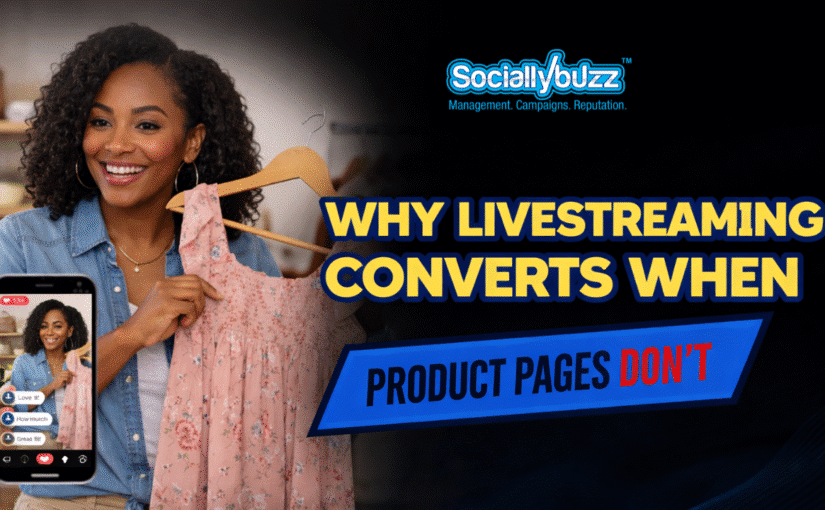
Livestreaming e-commerce is the practice of selling products or services through real-time video sessions on platforms such as Instagram Live, Facebook Live, TikTok Live, Amazon Live, or dedicated e-commerce platforms like Taobao Live. During a livestream, a host demonstrates products, answers questions in real time, interacts with viewers, and often provides clickable purchase links directly within the stream.
Instead of browsing passively, customers participate. Instead of guessing, they ask. Instead of hesitating, they watch others buy.
That interaction is why livestreaming consistently outperforms static product pages in conversion.
Traditional product pages are informational.
They present images, features, benefits, and reviews. They are structured for clarity and permanence. But they lack one critical element: real-time persuasion.
When a shopper lands on a product page, they must evaluate the product alone. If doubt appears, there is no immediate reassurance. If a question arises, there is no instant answer.
That hesitation creates drop-off.
Livestreaming removes that gap.
Real-time demonstrations eliminate ambiguity. Immediate Q&A reduces uncertainty. Limited-time offers introduce urgency. Visible participation builds momentum.
This combination activates buying psychology in a way static pages cannot replicate.
The effectiveness of livestreaming is not theoretical.
Alibaba reported that Taobao Live achieved a 32 percent conversion rate. In practical terms, that means for every 1,000,000 livestream viewers, approximately 320,000 items were added to shopping carts.
In 2020 alone, Alibaba generated $61.7 billion in gross merchandise value through its Taobao livestreaming platform.
By 2023, livestream social commerce sales in China were projected to reach over $281 billion, accounting for more than 60 percent of total social commerce sales in the country.
These figures demonstrate more than growth. They indicate structural change in consumer behavior.
Even in the United States, adoption is increasing. A Harris Poll found that 31 percent of U.S. adults have watched a livestream discussing a product or service. While only 7 percent reported purchasing directly, that gap reflects early-stage market development rather than lack of interest.
Markets mature. Behavior follows exposure.
China’s adoption curve offers a preview of what scaled livestream commerce looks like at full maturity.
Static product pages are always available.
Livestreams are temporary.
That time-bound nature creates urgency. Offers announced during live sessions often apply only while the host is streaming. Inventory updates happen in real time. Viewers know the opportunity may disappear.
This reduces the “I will think about it” delay that kills many online purchases.
Maybelline demonstrated this effect by selling 10,000 lipsticks in two hours through a livestream partnership. Estée Lauder’s Singles Day livestream reportedly generated approximately $300 million in product sales.
Urgency, combined with interaction, accelerates action.
On static pages, social proof is delayed and written.
In livestreaming, it unfolds live.
Viewers see comments appear. They watch purchases happen. They observe other customers asking questions and receiving answers. That visible engagement creates collective confidence.
Top livestreamers in China routinely attract over 100,000 viewers per session. Some have generated hundreds of millions of views monthly.
When participation becomes visible, perceived value increases. Humans respond to shared behavior. When others buy, hesitation decreases.
Livestreaming compresses weeks of accumulated reviews into one interactive event.
Cart abandonment is often driven by uncertainty.
Shoppers question product quality, fit, functionality, or compatibility. Static FAQs attempt to address these concerns broadly.
Livestreaming addresses them specifically.
Viewers can ask personalized questions and receive immediate clarification. The host can demonstrate features in response to real-time concerns. Objections are handled before they evolve into hesitation.
The faster doubt is resolved, the faster confidence forms.
Confidence drives conversion.
Product pages are polished.
Livestreams feel human.
Tone of voice, facial expressions, spontaneous responses, and unscripted moments create authenticity. Buyers feel like they are interacting with a real person rather than a curated brand page.
Trust builds faster when communication feels direct.
In competitive markets, trust often determines who wins the sale.
Livestreaming shortens the trust-building cycle by replacing static information with dynamic interaction.
Livestreaming does not eliminate the need for product pages.
It strengthens them.
Product pages provide structure and checkout infrastructure. Livestreaming drives urgency, engagement, and persuasion.
The most effective eCommerce strategies integrate both.
Livestreaming creates momentum. Product pages finalize the transaction.
Together, they form a stronger conversion system.
No. Conversion rate matters more than audience size. A smaller, highly targeted audience can outperform a large passive one. Relevance and engagement drive results more than volume.
Yes. While China leads in adoption, Western markets are rapidly expanding livestream commerce capabilities. Platforms like Instagram, TikTok, Amazon, and Facebook continue investing in shoppable livestream infrastructure.
Absolutely. Service providers can use livestreaming for live audits, demonstrations, Q&A sessions, consultations, and educational presentations. The same trust and urgency psychology applies.
Not necessarily. While urgency can improve results, clarity and demonstration alone can drive strong performance. Trust often converts better than price reductions.
Performance should be measured through conversion rate, watch time, engagement levels, click-through rates, and post-live revenue impact rather than views alone.
Often, they are an engagement problem.
Livestreaming converts better than static product pages because it activates urgency, builds trust faster, removes objections in real time, and amplifies social proof.
As digital commerce becomes more competitive, interaction will outperform isolation.
The question is no longer whether livestreaming works.
The question is whether brands are building structured strategies around it.
Sociallybuzz is a leading social media marketing, management, and digital advertising agency for small and medium-sized businesses. With over 17 years of experience as one of the first social media marketing agencies in the world, we know how to create and execute marketing campaigns that will help you grow your business. Our social media agency has created successful targeted social media campaigns that acquired our customers more leads, sales, and revenue.
Check out our insights on The Impacts of Social Media Marketing in the Restaurant Industry to see how specific strategies can influence different sectors.
Recommended: Restaurant advertising ideas and tips for food firms
Recommended: Learn How to Create Your Restaurants Social Media Marketing Strategy
Recommended: How to Run Facebook Ads for Restaurants
Read More:

Subscribe now to receive relevant social media information, tips, tricks and service updates.