

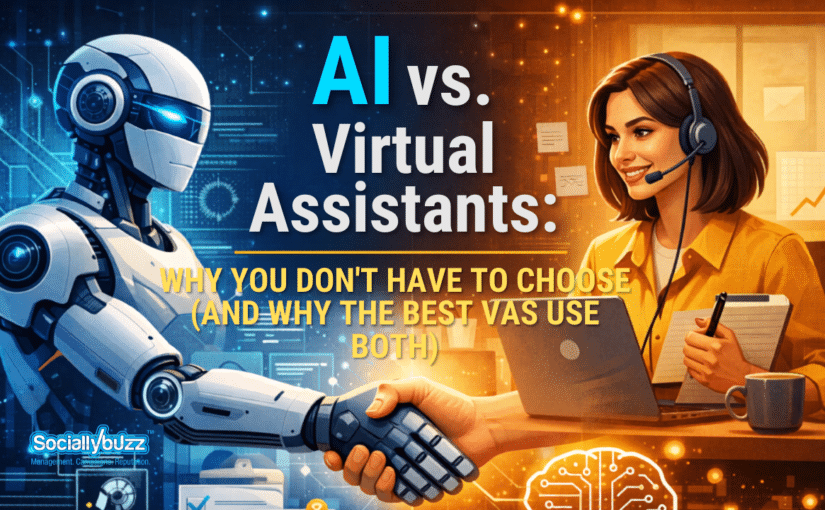
In the age of ChatGPT, autonomous AI agents, and tools that can “do things” while you sleep, the hot take making the rounds is: Do I still need a human virtual assistant?
But here’s the thing — that’s not the right question. The businesses winning right now aren’t choosing between AI and human virtual assistants. They’re combining both. And the secret weapon? A VA who actually knows how to leverage AI to multiply their output, sharpen their thinking, and get you more done in less time.
Let’s break this all the way down.
LISTEN TO THE LIVE PODCAST BELOW
You’ve probably heard the term “AI agent” thrown around a lot lately. But what does it actually mean?
Think of it this way. A traditional AI assistant — like asking ChatGPT a question or having Siri set a reminder — is reactive. You ask, it answers. One prompt, one response.
An AI agent is different. AI agents are proactive, working autonomously to achieve a specific goal by any means at their disposal. Unlike assistants, which suggest actions for users to approve, AI agents use multicomponent autonomy to independently reason, decide and problem-solve by using external data sets and tools.
IBM puts it beautifully with an analogy: imagine you’re a movie star. Your assistant handles tasks you ask for — dinner reservations, dry cleaning, calendar management. Your agent, on the other hand, is working around the clock to maximize your opportunities — even in ways you wouldn’t know to ask for. The key difference? One responds. The other acts.
Greater autonomy means that after an initial prompt, AI agents can continue working without further input, reducing the need for human intervention at every stage. Their ability to break out of a pure chat-based framework enables proactive decision-making and learning, ultimately saving employees time by handling complex workflows on their own.
A human VA is a remote professional who handles tasks, manages workflows, communicates with clients, and keeps your business running behind the scenes. They bring something no AI can fully replicate: judgment, context, and accountability.
A trained Virtual Assistant understands nuance — recognizing that one client needs a gentle nudge because they’re emotionally attached to a situation, while another needs speed over hand-holding. That’s human-AI collaboration in action.
Here’s what that looks like in practice. AI can draft an email — but it might not notice it’s responding to the wrong thread. AI can schedule a meeting — but it might miss that your CEO is already double-booked. AI is brilliant at clearly defined, low-risk tasks. But the second something requires judgment, accountability, or stakeholder management, human expertise becomes irreplaceable.
Here’s the truth nobody talks about enough:
A VA who uses AI tools isn’t competing with AI. They’re supercharged by it.
The companies crushing it this year aren’t choosing between AI and human VAs. They’re strategically deploying both — and the secret weapon is the human operator who knows how to make AI actually work.
Studies show AI users save over 30 minutes a day, and programmers using AI code twice as many projects a week. Now imagine a VA applying those same leverage ratios to your inbox, your research, your content, your client communications — and then adding their own judgment layer on top.
That’s not a virtual assistant anymore. That’s a force multiplier.
This is where it gets exciting. The AI landscape in 2025 and beyond isn’t just ChatGPT. There’s a whole ecosystem of powerful tools that a skilled VA can deploy strategically. Here’s what’s worth knowing:
Claude is a conversational AI assistant optimized for careful reasoning, high-quality writing, long document processing, and reliable instruction-following. For daily writing tasks — emails, proposals, documents, summaries — Claude is widely considered the gold standard. It follows detailed style instructions reliably, produces fewer generic phrases, and handles long-form content more consistently than most alternatives.
If your VA is drafting client communications, writing SOPs, building out content calendars, or processing long documents, Claude is the workhorse they should have open.
Perplexity is an AI-powered search engine that answers questions with real-time web sources cited directly in the response — designed for research, not just conversation. Think of it as Google Search that actually synthesizes the answer for you, with footnotes.
Perplexity’s interface is clean, its answers are grounded, and its ability to handle multi-hop reasoning — complex, layered queries — is unmatched. When your VA needs to research competitors, verify facts, pull industry data, or stay on top of what’s happening in your niche, Perplexity is the tool.
Manus launched in 2025 and positioned itself as the world’s first fully autonomous AI agent. The pitch is ambitious: give Manus a task and it will research, plan, execute, and deliver results without step-by-step guidance.
Under the hood, Manus orchestrates multiple AI models and specialized sub-agents to break down complex requests and carry them out autonomously. It can browse the web, create files, write code, and produce deliverables. For complex multi-step tasks — building a research report, running an analysis, generating an asset from scratch — Manus is uniquely capable.
For power users, entrepreneurs, or anyone with a hefty digital workload, Manus’s ability to automate complex sequences across web, code, and content can be a massive productivity booster.
Moltbot is one of the most interesting tools to emerge recently, and it signals where personal AI is headed. Moltbot — formerly known as Clawdbot — is described as the “AI that actually does things,” whether it’s managing your calendar, sending messages through your favorite apps, or checking you in for flights.
Unlike cloud AI tools, Moltbot runs on your own machine or server, connects directly to your chat accounts, and acts as your assistant — not a shared SaaS product. It connects to over 10 messaging platforms simultaneously — WhatsApp, Telegram, Slack, Discord, Signal, iMessage, Google Chat, Microsoft Teams, and more — from one AI brain.
Unlike a standard cloud-based chatbox that answers a question and stops, Moltbot answers and performs tasks locally. It also has a feature called persistent memory, meaning it remembers past conversations, preferences, and ongoing projects across sessions.
For a VA managing communications across multiple platforms, Moltbot is a glimpse of what a truly integrated AI assistant can look like.
Let’s make this concrete. Here’s what a great VA-plus-AI workflow looks like:
Research Tasks: Your VA uses Perplexity to gather real-time, cited data on a competitor or industry trend. Takes 10 minutes instead of 2 hours. They then review and synthesize the findings — because they know your business context and what actually matters to you.
Content & Communications: Your VA uses Claude to draft emails, proposals, or blog content at scale. They then refine it in your voice, catch anything off-brand, and make sure it lands right.
Complex Projects: For something like building a market research report or compiling a data-heavy deliverable, your VA spins up Manus to do the heavy lifting autonomously. They review the output and apply judgment before it reaches you.
Always-On Task Management: Tools like Moltbot mean your VA’s AI layer is working in the background — summarizing messages, flagging priorities, tracking calendar conflicts — even when your VA is offline.
AI handles volume; humans handle nuance. AI drafts; humans refine. AI pulls reports; humans review them, spot trends, and flag problems — like a sudden spike in shipping delays.
Let’s be honest about the limits. For all the impressive capabilities of today’s AI agents, there are real gaps.
When you work with a human Virtual Assistant, there’s a real person ensuring process compliance, catching errors with context, and escalating exceptions before they become lawsuits. There’s accountability. There’s a relationship. There’s institutional knowledge that has been built over months of working together.
The idea of “virtual assistant” is changing as we move into the AI agent age — voice bots and email assistants are evolving into proactive, autonomous digital agents. But AI is not just about having help; it’s about having capable, collaborative tools that make things happen.
The word collaborative is key. The most powerful setup isn’t AI replacing the human. It’s the human wielding AI like a professional-grade tool.
The “AI vs. VA” framing is a false choice. It’s like asking whether a surgeon should use their hands or their instruments. The answer is both — and the quality of the outcome depends on the skill of the person holding the tools.
AI won’t replace your Virtual Assistant. But a Virtual Assistant who knows how to leverage AI will replace the one who doesn’t.
So the real question to ask when evaluating your VA isn’t “Could AI do this instead?” It’s: “Is my VA using AI to bring me more value than they ever could alone?”
If the answer is yes — you don’t have an employee. You have a competitive advantage.
Will AI agents replace virtual assistants? Not likely — at least not entirely. AI agents excel at speed and repetition, but struggle with context, judgment, and relationship management. A VA who uses AI well will always outperform a VA who doesn’t, and will continue to add irreplaceable value that pure automation can’t match.
What AI tools should I ask my VA to use? Start with Claude for writing tasks, Perplexity for research, and ask your VA what tools they’re currently using. A good VA in 2025 should have a working AI toolkit and be able to explain how they use it.
Is it expensive to hire a VA who uses AI? The productivity gains typically more than offset any cost difference. Studies show AI users save over 30 minutes a day on average — and that’s just for individual users. A VA applying AI to your business tasks compounds those savings across every project they touch.
What’s the difference between an AI assistant and an AI agent? In short: chatbots follow scripts, assistants follow cues, and agents follow objectives. An AI assistant responds when asked. An AI agent pursues a goal autonomously, taking multi-step actions without waiting for each individual instruction.
Looking to hire a VA who knows how to leverage AI for your business? The best ones aren’t just task managers — they’re strategic operators who combine human judgment with the best tools available. That combination is the real competitive edge.
Subscribe now to receive relevant social media information, tips, tricks and service updates.