

Instagram gives you reach and engagement. TikTok gives you views and watch time. YouTube provides video analytics. X provides its own engagement data.
But there has always been another important question that was much harder to answer:
What happens when someone discovers your social media content through Google?
Google has now made that much easier to measure.
Google Search Console has introduced Platform Properties, allowing businesses, marketers, publishers and creators to connect their Instagram, TikTok, X and YouTube accounts directly to Search Console and see how that content performs across Google.
This means businesses can start identifying which social posts appear in Google, which searches are leading people to those posts, how often the content receives impressions and clicks, and which topics are gaining traction outside the social platform itself.
Google originally announced Platform Properties in July 2026, followed by a broader rollout of the feature.
For business owners, this is more than another analytics update.
It is another sign that the line between SEO and social media marketing is becoming increasingly difficult to separate.
LISTEN TO THE LIVE PODCAST HERE
Traditionally, Google Search Console has been primarily associated with websites.
Businesses use it to understand how their website appears in Google Search, including which keywords generate visibility, which pages receive clicks and how their organic search performance changes over time.
Platform Properties extend that visibility beyond your website.
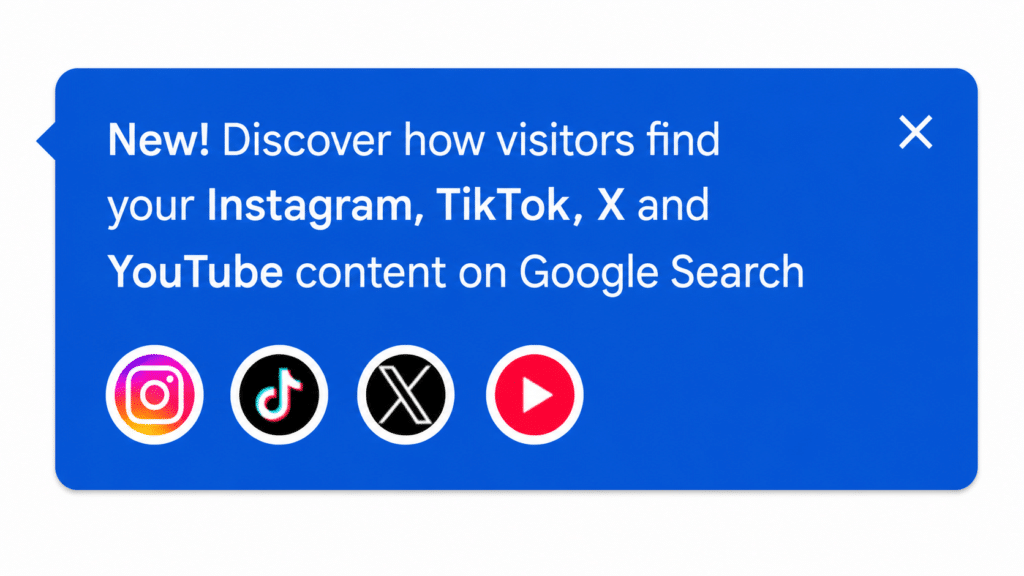
Businesses can now add supported social accounts or channels as individual Search Console properties.
The four platforms currently supported are:
Once the account is connected and verified, Search Console can report on how content from that platform performs when people encounter it through Google.
Importantly, you do not need to own a website to use this feature for a supported social account.
This makes Search Console more useful to creators, local businesses and social-first brands that previously may not have had much reason to use the platform.
Google had already been experimenting with giving businesses greater visibility into how social content performs in Search. Platform Properties expands that idea into standalone properties that businesses can connect and monitor directly.
After connecting a supported social account, businesses gain access to several Search Console reports.
The Performance Report is where businesses can dig into the numbers.
Search Console can show metrics such as:
Clicks: How often someone clicked your social content from Google.
Impressions: How often your content appeared in Google Search.
Click-through rate: The percentage of impressions that resulted in clicks.
Average position: The average position associated with your content when it appeared in Search.
Businesses can then filter the information to identify individual posts and search queries responsible for their Google visibility.
This creates an entirely new layer of social media measurement.
A Reel may receive only moderate engagement on Instagram, for example, but could continue generating impressions from Google months after it was published.
Without this information, that contribution could easily go unnoticed.
The Insights Report gives marketers a simpler overview of what is happening.
Instead of analyzing every individual metric, businesses can use it to understand recent traffic trends, discover their strongest-performing posts and see how people are finding their content.
Businesses can also review search queries that are gaining or losing visibility.
This can become valuable content-planning data.
Imagine a restaurant discovers that its Instagram content is consistently being found through searches relating to:
“best brunch in Miami”
“Miami birthday restaurants”
“outdoor dining Miami”
Those are no longer just SEO keywords.
They are potential subjects for Reels, videos, captions, landing pages, paid advertising and future content campaigns.
Search Console can also highlight milestones based on Search performance.
These achievements can help businesses recognize when their social content reaches new levels of Google traffic, such as reaching a new click milestone during a particular period.
While these milestones may not be as strategically important as query and content data, they can still help businesses identify long-term growth.
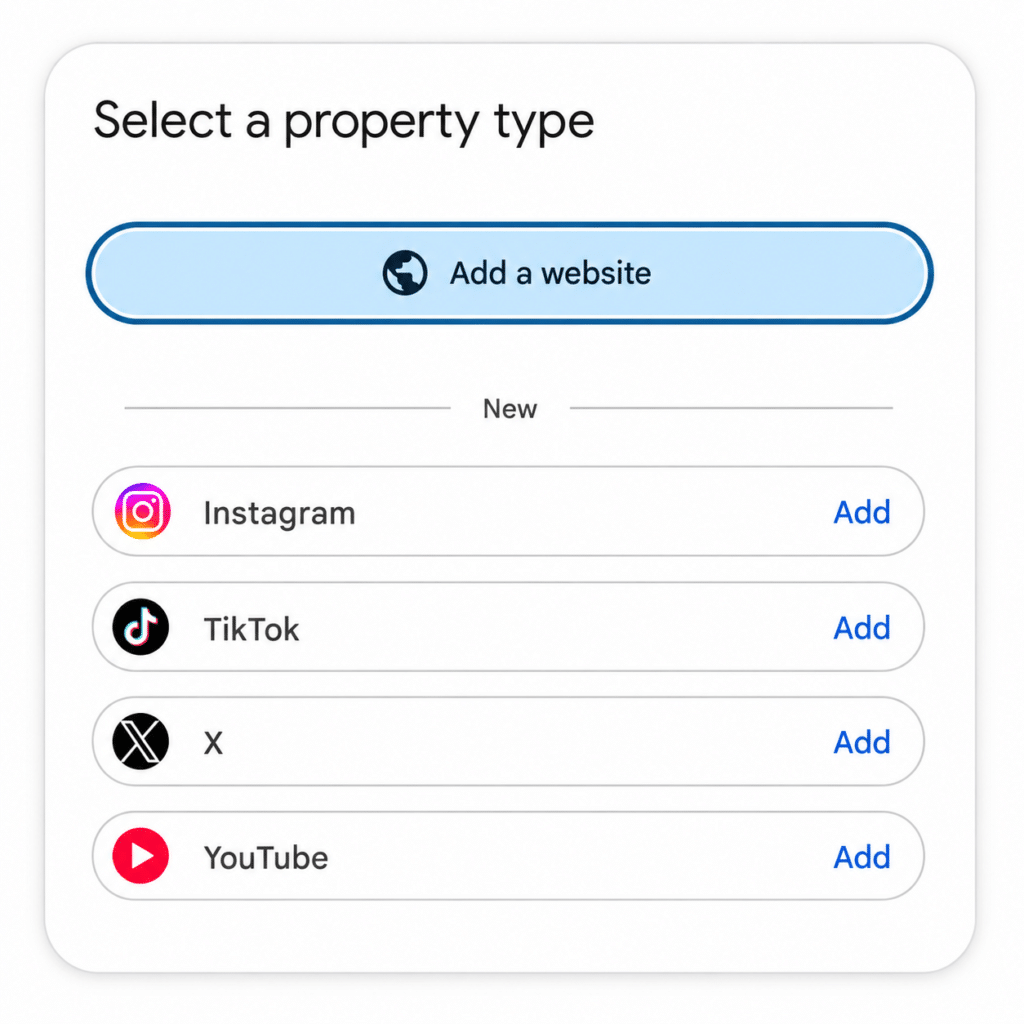
Setting up a Platform Property is relatively straightforward.
Open Google Search Console and select Add Property from the property selector.
Instead of only seeing traditional website options, you can now choose supported social and video platforms.
Select the platform you want to connect and follow the verification process.
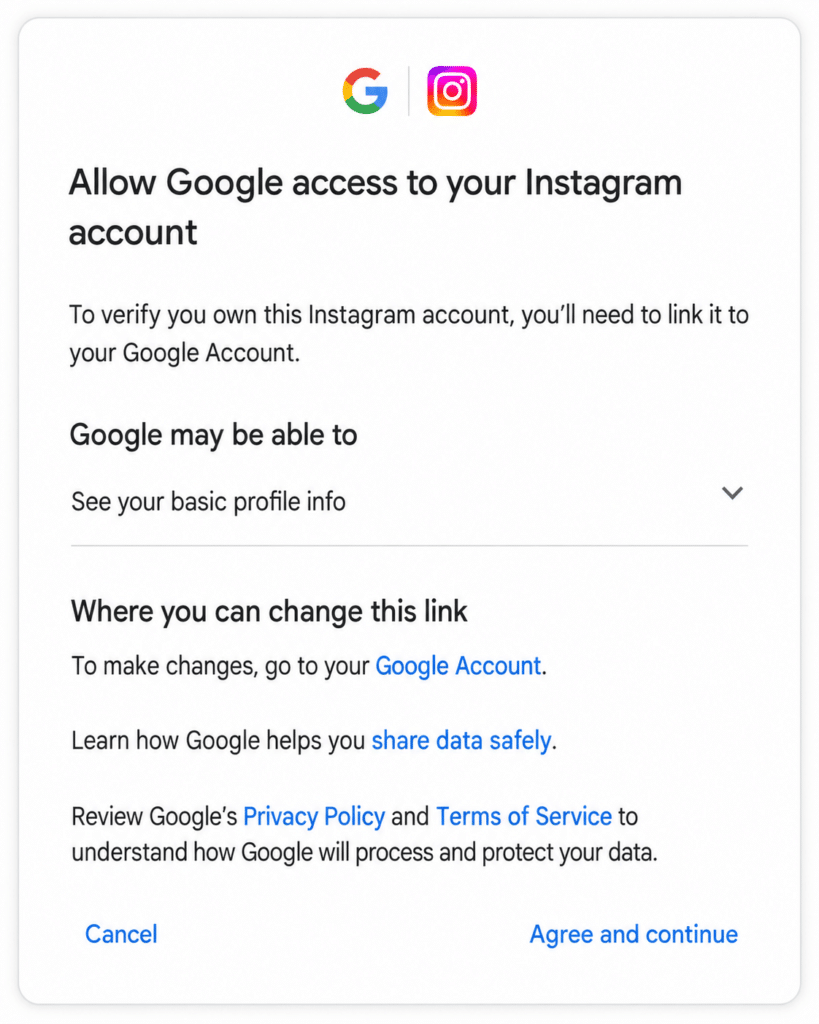
You will be asked to authorize the connection and verify that you control the account or channel.
Once ownership is verified, Google begins collecting performance information for that property.
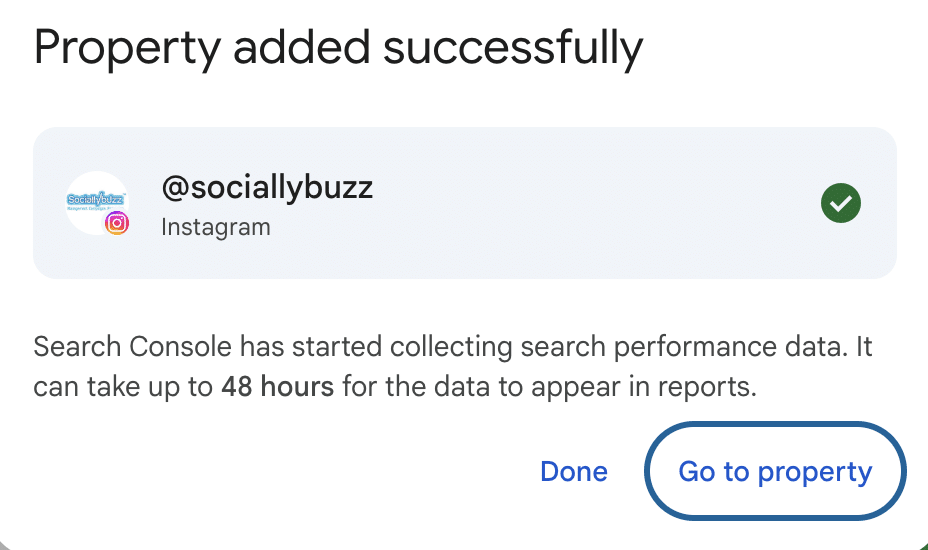
Newly connected properties may not display information immediately because Google needs time to begin collecting and processing the data.
During our own SociallyBuzz Instagram setup, Google confirmed that Search performance data could take up to 48 hours to begin appearing.
If you manage several brands or profiles, each account can be added as its own Platform Property.
At first glance, this may sound like an analytics feature mainly for SEO professionals.
Its implications are much broader.
Businesses increasingly publish useful information directly on social media instead of restricting that information to their websites.
A restaurant might publish a Reel explaining its catering options.
A contractor might upload a video answering how much a renovation typically costs.
A franchise may post an Instagram carousel comparing products.
A dentist might publish a short video answering a common patient question.
A retailer could create a TikTok demonstrating how a product works.
Historically, marketers might judge these posts primarily through social metrics such as views, shares, comments and saves.
But if Google can surface that content when somebody searches for the subject, the post has another job:
search discovery.
Platform Properties finally give businesses greater visibility into that part of the customer journey.
Businesses have traditionally separated their marketing channels.
SEO belonged to the website.
Social media belonged to Instagram, TikTok or Facebook.
Video belonged to YouTube.
Paid media sat somewhere else entirely.
Customer behavior does not follow those boundaries.
Someone might discover a business on TikTok, Google its name, watch one of its YouTube videos, browse Instagram and finally visit the website.
Another customer might begin directly on Google and discover an Instagram post before ever reaching the company’s website.
People are increasingly consuming different formats when researching products, services, businesses and topics online.
The practical takeaway for marketers is simple:
Your social content should not be created only for the social feed anymore.
It should also clearly communicate what the content is about.
That means content strategy increasingly benefits from understanding how customers actually search.
There is an important distinction businesses should understand.
Connecting your Instagram or TikTok account to Search Console does not automatically improve its Google rankings.
Platform Properties are primarily a measurement and reporting feature.
Google was already capable of surfacing social and video content in Search. Search Console now gives account owners better visibility into when and how that discovery happens.
Think of it like installing better analytics.
The analytics do not create demand.
They show you where demand already exists so you can make smarter marketing decisions.
That distinction matters because businesses should not simply connect their profiles and expect more Google traffic.
The opportunity comes from what they do with the information afterward.
Rather than simply checking your numbers every month, businesses can incorporate Platform Property information into their larger content strategy.
Start with the search queries generating impressions and clicks.
Those queries can reveal the language customers naturally use when searching for your products, services or expertise.
If one topic repeatedly generates Search visibility, create more content around it.
A successful 30-second video could become:
One piece of Search data can potentially inform multiple marketing channels.
A social post receiving many impressions but relatively few clicks deserves investigation.
The topic may be relevant, but the presentation may not be compelling enough.
Depending on the platform, consider reviewing the title, caption, thumbnail, opening message or overall positioning of the content.
This is similar to traditional SEO.
If people can see your content in Search but they are not choosing it, something may need improvement.
Another valuable opportunity is identifying older posts that suddenly begin generating Search traffic again.
Instead of allowing that momentum to disappear, businesses can repurpose or expand the subject.
You could:
This is especially important because search demand often behaves differently from social feeds.
Social content can disappear quickly from somebody’s feed.
Searchable content can potentially become relevant again whenever people start looking for that subject.
If one of your posts suddenly begins attracting more Google traffic, that may indicate increasing interest in the topic.
Businesses can respond while the interest is still active.
That could mean creating additional content, publishing across another platform, expanding the topic into an article or incorporating it into a promotion.
Instead of relying only on trend reports from outside sources, businesses can begin spotting trends through their own content performance.
Businesses often invest heavily in multiple social platforms without knowing which one contributes most to discovery outside its native environment.
Platform Properties can help marketers compare Search performance across supported channels.
You may discover that Instagram generates significantly more Google impressions while YouTube produces fewer impressions but stronger click-through rates.
TikTok may perform strongly for certain topics while YouTube generates better Search visibility for educational content.
That information can help determine which platforms deserve greater investment for different kinds of content.
This may ultimately be one of the biggest benefits of the update.
Social media reporting has trained businesses to focus heavily on immediate engagement.
A post receives 200 likes.
Another receives 15,000 views.
Another gets 40 shares.
Those numbers have value, but they do not always tell you whether the content is helping potential customers discover your business.
Platform Properties introduce another important question:
Is this content creating long-term search visibility?
For businesses investing time and money into content creation, that is an important distinction.
A post does not necessarily stop creating value once it disappears from somebody’s Instagram or TikTok feed.
If the content answers something people continue searching for, it may become part of a broader organic discovery strategy.
If your business actively publishes on Instagram, TikTok, YouTube or X, connecting those accounts to Google Search Console should now become part of your analytics setup.
But connecting the account is only step one.
The larger opportunity is building a marketing process that connects:
Search behavior → content creation → social distribution → performance measurement → optimization.
Review what customers are searching for.
Identify which posts already generate Search impressions.
Look for subjects that repeatedly appear.
Compare platforms.
Refresh promising content.
Expand successful topics into additional formats.
And use the information to plan future campaigns instead of relying entirely on assumptions about what audiences want.
Google has effectively given marketers another source of customer-intent data.
The businesses that benefit most will be the ones that actually use it.
Google Search Console’s Platform Properties may look like a relatively small product update, but they reflect a much bigger shift in digital marketing.
A business’s online visibility is no longer determined only by the pages on its website.
Customers can discover the brand through a Google result, Instagram Reel, TikTok video, YouTube tutorial, review, local listing or several of those touchpoints before making a decision.
The goal should therefore not be simply to “do SEO” and “do social media” separately.
The goal is to build a digital presence where your brand can be discovered whenever and wherever your customers start looking.
Platform Properties give businesses another valuable tool for understanding whether that is actually happening.
Yes. Supported social and video accounts can be connected to Search Console even if you do not operate a website. This makes the feature especially useful for social-first businesses, creators and brands.
The connection is completed through an account authorization and verification process. Businesses should always use the official authorization screens rather than manually sharing their Instagram credentials.
No. Connecting the account does not automatically improve rankings. Platform Properties primarily give you additional performance data so you can understand how your content is being discovered through Google.
No. Search Console focuses on performance connected to Google Search and related Google discovery surfaces. Your platform analytics will still be necessary for understanding views and engagement that happen directly inside Instagram, TikTok, YouTube or X.
Yes. Businesses managing multiple brands, profiles or channels can create individual properties for supported accounts and analyze their Search performance separately.
Businesses should first create useful content for real customers. However, understanding what customers search for can help you create stronger topics, captions, titles and videos. Social content that directly answers common customer questions may also have greater potential to attract Search visibility.
Review which queries are triggering the content first. If they are relevant to your business, look at whether the post clearly communicates its value. Titles, thumbnails, captions, opening hooks and topic positioning may all influence whether someone chooses to click.
Getting more data is useful. Knowing what to do with it is where the real value begins.
At SociallyBuzz, we help businesses connect SEO, social media, paid advertising, content strategy and digital marketing so every channel works toward the same goal: generating greater visibility, stronger customer engagement and measurable business growth.
If you want to understand how your business can take advantage of changes like Google Search Console Platform Properties and turn that information into a smarter marketing strategy, contact SociallyBuzz today or schedule a 15-minute strategy call with our team.
Subscribe now to receive relevant social media information, tips, tricks and service updates.
