
Google Business Profiles have been a cornerstone of local business discovery for years. When someone needs a restaurant, salon, retailer, contractor, or service provider nearby, Google Search and Google Maps have traditionally been among the first places they look.
Now another major discovery platform is giving businesses more control over how they appear.
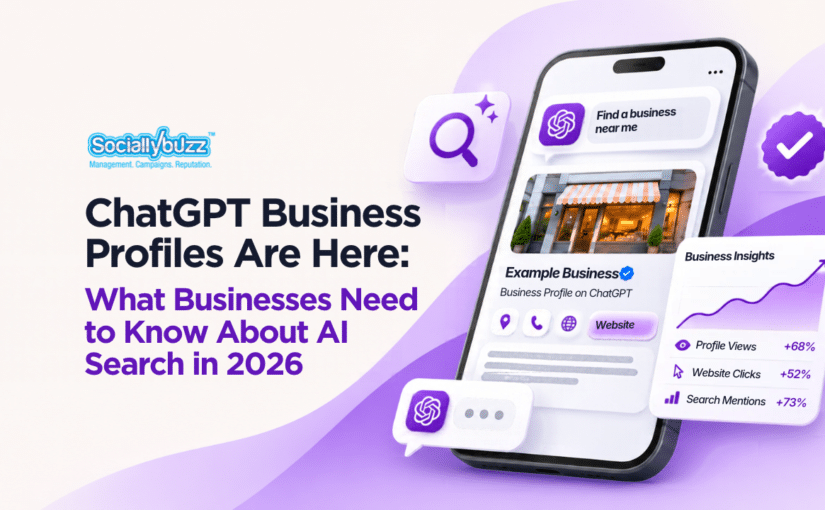
On November 10, 2026, OpenAI introduced Businesses in ChatGPT in beta, with Business Hub available as the management hub where eligible businesses can claim their presence, update company information, view engagement insights, and, in some cases, create an AI-powered Business Agent that can interact with prospective customers. (openai.com)
Does that mean ChatGPT is replacing Google Business Profiles?
No.
What it does mean is that the way consumers discover businesses is becoming more fragmented. Search engines, Maps, social media, reviews, and AI assistants are increasingly working together throughout the customer journey.
For businesses, that creates a new marketing priority: it is no longer enough to think only about how your brand appears in Google. You also need to understand how your business is being represented when consumers ask AI for recommendations.
LISTEN TO THE LIVE PODCAST HERE
The launch of Business Hub arrives at a time when consumers are already experimenting heavily with AI as a discovery tool.
SOCi’s 2026 Local Discovery Index found that 52% of U.S. consumers surveyed had used AI tools to research a local business within the previous 30 days. Search engines remained the most widely used channel at 83%, while social media was used by 55%. (soci.ai)
BrightLocal has documented a similar shift. Its 2026 consumer research found that 45% of consumers had used AI tools for local business recommendations during the previous year, up significantly from the year before. (brightlocal.com)
That does not suggest traditional search is disappearing.
Instead, the customer journey is becoming more complex.
BrightLocal found that 75% of consumers used more than one channel during their most recent search for a local business. Among consumers who began with an AI tool, 43% later checked Google and 39% continued their research on social media. (brightlocal.com)
In other words, a customer might ask ChatGPT for restaurant recommendations, check the restaurant on Google Maps, browse its Instagram account, read reviews, and only then make a reservation.
Businesses now need to be credible at every one of those checkpoints.
Businesses in ChatGPT gives eligible organizations a way to claim and manage information about their company through OpenAI’s Business Hub.
After verification, businesses can provide or update details about what they offer. Retailers can also connect product information, including pricing and availability, allowing ChatGPT to potentially use more current business-supplied information when helping users explore products and services. (openai.com)
This is important because AI assistants do not operate like traditional business directories.
People rarely search ChatGPT using only a business name.
They may ask questions such as:
“What’s a good restaurant for a birthday dinner near me?”
“Where can I buy a gift under $50?”
“Which local marketing agency works with restaurants?”
“What’s a good salon nearby that offers bridal makeup?”
“Which of these products is better for what I need?”
The business is appearing inside a conversation rather than simply inside a list of search results.
That means the quality, clarity, and accuracy of the information associated with the business can become increasingly important.
One of the most interesting parts of Business Hub for marketers is the introduction of visibility data.
Verified businesses can access aggregated insights showing activity such as mentions and website clicks, along with discovery topics that indicate the types of conversations in which the business is appearing. OpenAI’s help documentation states that these insights cover the previous 28 days. (help-lb.openai.com)
For an online business, OpenAI says a mention is counted when ChatGPT references the company’s website rather than merely stating the brand name. For a local business, a mention can occur when ChatGPT displays that location as a result. (help-lb.openai.com)
That gives marketers a new set of questions to ask.
What topics cause ChatGPT to mention our business?
Are customers clicking through to our website?
What products or services appear to be associated with our brand?
Are competitors appearing in conversations where we should also be considered?
This begins to make AI visibility measurable, instead of leaving businesses to simply wonder whether AI platforms know they exist.
Importantly, businesses do not receive access to individual customer conversations. OpenAI says these insights are aggregated and only displayed when enough activity exists to satisfy privacy thresholds. (openai.com)
This point is especially important.
Claiming a ChatGPT business profile does not mean the business will automatically appear more frequently or receive preferential recommendations.
OpenAI explicitly states that claiming a business does not guarantee higher placement or sales. ChatGPT continues to make recommendations and comparisons independently. (openai.com)
The better way to think about Business Hub is as a tool for accuracy and participation, not a shortcut to the top of AI recommendations.
A verified business can help ensure that important information about its operations, products, services, and availability is current.
But AI visibility still depends on a broader digital footprint.
BrightLocal analyzed more than 200,000 local AI searches in 2026 and found that traditional Google Maps visibility did not translate directly into AI visibility. However, business websites remained extremely important: 93% of the unique domains used as AI sources were business websites, accounting for 42% of all citations analyzed. (brightlocal.com)
That suggests businesses should not look for one new “ChatGPT SEO trick.”
Your website still matters.
Your business information still matters.
Your location information still matters.
Your reviews still matter.
Your authority across the web still matters.
And now, the consistency of those signals across AI, search, social, Maps, and other platforms matters even more.
The rise of AI discovery does not mean businesses should abandon Google Business Profile.
BrightLocal’s 2026 research found that 52% of consumers began their most recent local search on Google Search and another 9% started on Google Maps. Overall, 71% used Google at some point during the process. (brightlocal.com)
AI was part of the journey, but rarely the only step.
Only 18% of consumers who used AI for local search said they were ready to contact the business immediately after receiving an AI recommendation. Most continued researching through Google or another platform before making their decision. (brightlocal.com)
This is why the idea that ChatGPT has suddenly “replaced” Google Business Profiles is misleading.
The more realistic shift is from single-platform optimization to multi-platform visibility.
A customer may discover you through ChatGPT but verify you through Google.
They may discover you through TikTok and ask ChatGPT to compare you with another business.
They may find you on Google Maps and then use AI to understand which option better fits their needs.
The winning business is increasingly the one whose information remains trustworthy wherever the customer decides to check.
OpenAI is also introducing Business Agents, which take the idea beyond a static business profile.
For eligible ecommerce and online service businesses in the United States, a verified company can currently build an AI agent that customers can choose to chat with inside ChatGPT. The agent can answer questions using information provided by the business about its products, policies, and offerings. (openai.com)
Imagine a customer comparing two products.
Instead of leaving ChatGPT, opening several browser tabs, searching the company’s FAQ page, and trying to find the answer, the customer could potentially ask the company’s Business Agent which option fits their needs.
For businesses, this introduces an interesting shift.
Discovery can potentially become conversation.
And conversation can move someone closer to action.
Business Agents remain limited to eligible categories and markets at launch, but OpenAI says it intends to expand the capability to more businesses over time. (openai.com)
The first step is straightforward: if your business is eligible, consider claiming it through Business Hub and verify that the information associated with your business is accurate.
But claiming the profile should be the beginning of the strategy, not the entire strategy.
Businesses should also review whether their website clearly communicates what they do, where they operate, who they serve, what products or services they offer, and why customers should trust them.
Make sure pricing, availability, contact information, addresses, hours, and service descriptions remain consistent across your website, Google Business Profile, social media, directories, review platforms, and other important sources.
Then start paying attention to the questions customers ask.
If people repeatedly ask whether your restaurant accommodates large groups, create a clear page answering it.
If customers compare several versions of your product before buying, publish useful comparison content.
If people are trying to understand which service is right for them, make that information easier to find.
AI search favors businesses that can answer questions clearly because customers themselves are increasingly searching in the form of questions.
The strategy is not simply to optimize for an algorithm.
It is to make your business easier for both humans and AI systems to understand.
Perhaps the biggest marketing lesson from Businesses in ChatGPT is not that businesses suddenly need to abandon everything they were doing before.
It is the opposite.
The customer journey is becoming increasingly connected.
SOCi’s research describes this as a “verification loop”: consumers discover businesses through one channel, verify them elsewhere, and use multiple signals before deciding. Its 2026 study found that 83% used search engines, 55% used social media, and 52% used AI to discover local businesses. (soci.ai)
That makes consistency more important than ever.
Your Google presence should support your website.
Your website should support your social media.
Your reviews should reinforce your reputation.
And your ChatGPT business information should reflect the same accurate story.
Businesses that treat AI search as an entirely separate marketing channel may miss the bigger opportunity.
The future of discovery is increasingly about being findable, understandable, and trustworthy everywhere customers look.
No. They are separate products from different companies. Business Hub allows eligible businesses to claim and manage information associated with their presence in ChatGPT, while Google Business Profile manages business information across Google properties such as Search and Maps.
Consumers may use both platforms during the same buying journey.
No. OpenAI states that claiming your business does not guarantee better placement, more recommendations, or increased sales. Claiming primarily gives eligible businesses greater ability to manage accurate information and access insights about their presence in ChatGPT. (openai.com)
Verified businesses can access aggregated insights including mentions, website clicks, and discovery topics showing common themes where their business appears. OpenAI does not provide businesses with users’ individual ChatGPT conversations. (openai.com)
Not currently. At launch, Business Agents are available to eligible ecommerce and online service businesses in the United States. OpenAI says availability is expected to expand over time. (openai.com)
Yes. Current consumer research continues to show that Google plays a major role in local discovery and verification. AI search should be considered an additional discovery channel rather than a reason to stop investing in Google, websites, reviews, and social media. (brightlocal.com)
AI search optimization is the broader practice of making a business and its information easier for AI-powered discovery systems to understand and potentially cite or recommend. It overlaps heavily with traditional SEO, local SEO, content strategy, reputation management, and accurate business listings rather than replacing those disciplines.
Customers are no longer searching in only one place.
They may discover your business through Google, social media, Maps, reviews—or increasingly, through an AI conversation.
SociallyBuzz helps businesses build digital marketing strategies designed for the way customers actually discover and evaluate brands today, from search and local marketing to social media, content, reputation, and emerging AI discovery channels.
The question is no longer simply whether your business ranks on Google.
It is whether customers can find, understand, and trust your business wherever they choose to search.
Subscribe now to receive relevant social media information, tips, tricks and service updates.