

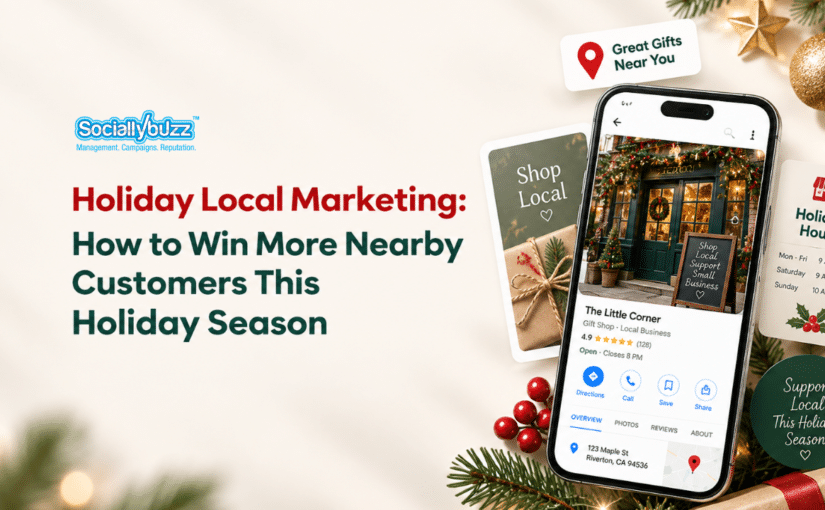
The holiday season creates a unique advantage for local businesses.
While major retailers compete nationally for clicks, impressions and online orders, restaurants, retailers, salons, service businesses and brick-and-mortar brands have something large ecommerce companies cannot always replicate: proximity, convenience and community.
A customer may begin December searching online for the perfect gift. A week later, that same customer may be searching for a store nearby because shipping deadlines are approaching. Someone planning a holiday dinner might search for a restaurant close to home. Another customer may suddenly need a salon appointment before a Christmas party, a local gift card for a coworker or a retailer offering same-day pickup.
These moments create valuable opportunities for businesses that are easy to find locally.
BrightLocal’s 2025 research found that 85% of consumers consider contact information and opening hours important when researching local businesses, while one in five consumers conducts local searches directly inside map platforms. Nearly one-quarter of consumers also said between 41% and 60% of their online searches have local intent.
At the same time, consumers continue to show strong interest in supporting independent businesses during the holidays. American Express reported that 86% of surveyed consumers planned to Shop Small during the 2025 holiday season, either online or in person. Small business owners surveyed also expected nearly 20% of their annual revenue, on average, to come from Small Business Saturday alone.
That means holiday local marketing in 2026 should not simply mean putting a Christmas sign outside your store.
It means making your business easier to find, visit, contact and buy from throughout the entire holiday season.
LISTEN TO THE LIVE PODCAST HERE
Holiday buying behavior changes as Christmas approaches.
Earlier in the season, customers may have time to compare brands, browse online and wait for delivery. Later, convenience becomes more important.
Customers begin asking different questions.
Where can I get this nearby?
Is the store open tonight?
Can I pick it up today?
Do they still have it in stock?
Can I book before Christmas?
Is there somewhere close by where I can buy a last-minute gift?
That is why a local holiday strategy connects digital visibility with the real-world customer experience.
Your website, Google Business Profile, Maps presence, social media, reviews, advertising, store information and physical location should all tell the same story.
If your Instagram says you are open until 8 PM but Google says 6 PM, the customer may go somewhere else.
If your website promotes local pickup but the option is impossible to find, convenience disappears.
If someone discovers your restaurant on Maps but cannot tell whether you are accepting holiday reservations, you may lose the booking.
During the holidays, accurate local information becomes part of marketing.
For local businesses, your Google Business Profile may be one of the most important marketing assets you have during the holidays.
It influences how your business appears across Google Search and Google Maps, where potential customers may be looking for restaurants, stores, salons, services or products nearby.
Google explains that local results are primarily based on relevance, distance and prominence. Complete business information can help Google understand what a business offers and match it with relevant searches, while reviews and links can also contribute to prominence.
Before the holiday rush, businesses should therefore review the entire profile rather than treating it as something that was set up once and forgotten.
Make sure the address, website, phone number, business category and regular operating hours are accurate. Review the attributes associated with the business and make sure they still reflect what customers can expect.
Google Business Profile attributes can communicate useful information about a location, such as amenities, payment options or other business-specific features. These attributes appear across Google Search and Maps and can help customers evaluate whether a business fits what they need.
For a restaurant, this might mean making sure dining information is accurate.
For a retailer, customers may want to know what products are available.
For a service business, they may want to understand where you operate or how to contact you.
The holiday season is not the time to discover that your most visible local listing still contains information from six months ago.
Holiday hours may seem operational rather than promotional.
But during the holidays, they directly affect whether someone visits.
BrightLocal found that opening hours and contact information are among the most important pieces of information consumers look for when researching local businesses.
Google allows businesses to set special hours when normal operating times temporarily change for holidays, events or other exceptional circumstances. Google even recommends confirming official holiday hours when they remain the same so customers know the information is current.
This matters because holiday schedules are rarely normal.
You may stay open later before Christmas.
You may close earlier on Christmas Eve.
Your restaurant may run special holiday service hours.
Your salon may add appointment slots.
Your business may close completely on Christmas Day.
Those changes should be reflected wherever customers expect to find them.
Do not stop at Google. Make sure your website, social media profiles, online booking tools and other major listings communicate the same information.
A customer should never have to guess whether your business is open.
Being visible on Maps is only the beginning.
Your profile also needs to convince someone that your business is worth visiting.
Photos can play an important role here.
Google specifically recommends adding business-specific photos because they help customers understand what a business offers and can help the profile stand out. Depending on the business, this could include exterior images, interior photographs, product photos, food and drinks, employees or people performing services.
During the holiday season, update those visuals when appropriate.
A restaurant could showcase its seasonal menu or decorated dining space.
A retailer could photograph holiday merchandise, gift bundles or window displays.
A salon might show seasonal styles or the experience customers can expect.
A service company could feature its team working with clients.
The images should still accurately represent the business. Google advises using clear, well-lit photos that reflect reality rather than heavily altered imagery.
The purpose is simple: by the time someone opens your Maps listing, they are often already evaluating whether your business deserves the next step.
Give them enough information to feel confident making it.
Your Google Business Profile does not have to remain static during the holidays.
Google allows businesses to publish updates, offers and events directly through the profile. Those posts can appear when customers encounter the business through Search or Maps.
This creates another local marketing opportunity.
A restaurant could promote a Christmas brunch.
A retailer could publish its Small Business Saturday offer.
A salon could announce limited holiday appointments.
A local attraction could promote a Christmas event.
A service provider could announce special December availability.
Google’s offer posts can include promotional details, dates, links and coupon codes, while event posts can include dates, times, images and calls to action.
That means your Google presence can support your holiday campaign rather than simply serving as a digital directory listing.
If customers are already discovering the business locally, show them what is happening now.
As Christmas gets closer, speed becomes increasingly important.
A customer who was willing to wait for shipping in November may be looking for same-day or next-day pickup by mid-December.
Brick-and-mortar retailers should make this convenience highly visible.
If you offer local pickup, communicate it across your website, Google presence, social media, email campaigns and advertising.
Do not hide it at checkout.
Use clear language such as:
Available for Local Pickup
Order Online, Pick Up Today
Ready for Pickup in Store
Skip the Shipping Deadline
Retailers using Google Merchant Center may also be eligible for free local listings or local inventory ads, which can show nearby shoppers the products available at physical locations. Google’s local inventory tools can also highlight pickup options.
Google reports that retailers combining local inventory ads with Shopping ads saw a 21% increase in store visits and a 9% increase in online conversions for products available in-store, based on its global data from July 2023 through July 2024.
For retailers already using Google Shopping, this is particularly relevant in 2026: Google began enabling local inventory ads by default for Shopping campaigns on August 31, 2026, so businesses using local product feeds should review how their inventory and campaign settings are configured ahead of holiday advertising.
The closer Christmas gets, the more valuable the word nearby can become.
Local SEO during the holidays should go beyond your homepage.
Customers searching locally often have specific intent.
They might search for a Christmas dinner in Miami, holiday catering in Fort Lauderdale, a gift store near them, a salon open on Christmas Eve or a local service available before the end of the year.
Your website should provide pages that help answer those searches when appropriate.
A restaurant might create a page for its holiday menu and reservations.
A salon could publish holiday booking information.
A retailer could create a local gift guide or pickup page.
An event venue could publish Christmas and New Year’s availability.
A home service provider could explain its December operating schedule.
These pages should clearly communicate the location, offer, availability, hours and next step.
Avoid creating dozens of low-value pages simply to insert city names.
The goal is not to manufacture local keywords.
The goal is to create genuinely useful pages for people who have local intent.
For independent businesses, Small Business Saturday is one of the biggest local marketing opportunities of the holiday season.
In 2026, Thanksgiving falls on Thursday, November 26, which means Black Friday falls on November 27 and Small Business Saturday falls on Saturday, November 28.
The opportunity can be significant.
American Express estimated that consumers reported spending approximately $18 billion at small businesses on Small Business Saturday in 2025. The company also reports that every dollar spent at a U.S. small business leaves an estimated 68 cents within the local community through direct and indirect economic activity.
Instead of publishing one “Shop Small” graphic on Saturday morning, businesses can build anticipation before the event.
Tell the story behind the business.
Introduce the owner or team.
Explain what makes the business different.
Highlight products or services customers may not know about.
Create an exclusive local offer.
Partner with other small businesses nearby.
Encourage customers to turn the day into an experience rather than a single transaction.
Your advantage over a national retailer is not necessarily price.
It may be personal connection, convenience, expertise and community.
Use those differences.
Holiday marketing does not have to be competitive all the time.
Local businesses can often become stronger by creating reasons for customers to visit an entire neighborhood, district or group of businesses.
A coffee shop could partner with a bookstore.
A salon could collaborate with a local boutique.
A restaurant and nearby entertainment venue could create a holiday date-night promotion.
A bakery could provide treats for a local retailer’s shopping event.
A group of businesses could create a holiday passport encouraging customers to visit multiple locations.
The advantage is shared reach.
Each business gains exposure to another local audience while giving customers a more interesting reason to participate.
Partnerships can also create better content.
Instead of another promotional graphic, you can publish stories about the businesses, people and community behind the collaboration.
That type of local identity is difficult for large national competitors to copy.
Events can bring local marketing online and offline together.
Retailers might host late-night shopping events.
Restaurants can run holiday tastings or themed evenings.
Salons could hold customer appreciation days.
Fitness businesses might host seasonal classes.
Professional service businesses could organize networking events, workshops or community drives.
The event itself is only part of the marketing opportunity.
Before the event, promote it through social media, email, your website, Google Business Profile and community calendars.
During the event, encourage photos, customer participation and social sharing.
Afterward, use the resulting content to show other potential customers what it feels like to interact with the business.
Google Business Profile also allows eligible businesses to publish event posts with dates, times, descriptions, photos and calls to action, giving local customers another way to discover what is happening.
A good holiday event can therefore generate traffic, content, community engagement and future marketing assets at the same time.
Reviews are especially important when customers are choosing between businesses they have never visited before.
BrightLocal’s 2025 Local Consumer Review Survey found that Google remained the leading platform consumers used when researching local business reviews. The research also found that consumers increasingly want detailed, credible information and frequently compare different experiences before forming an opinion about a business.
Holiday traffic can create an opportunity to generate more genuine customer feedback.
If someone has a positive experience, make it easy for them to leave a review.
You might include a review link in post-purchase communication, on a receipt or in a follow-up message.
But avoid incentivizing positive reviews or trying to manipulate the process.
The objective should be to encourage authentic feedback from real customers.
Businesses should also respond.
Google says responding to reviews demonstrates that a business values customer feedback, and positive reviews and helpful responses can help a business stand out in local results.
This becomes particularly important during busy holiday periods, when potential customers may be evaluating whether a business can deliver a reliable experience under pressure.
Local marketing should also influence what you publish on social media.
A neighborhood business does not need to make every post look like content from a national brand.
Show the location.
Show the people behind the business.
Show the neighborhood.
Feature regular customers when appropriate.
Talk about local events.
Highlight nearby businesses.
Share what is happening in the community.
If weather, traffic, local events or holiday schedules affect customers, communicate those updates.
A restaurant can show what Saturday night actually looks like.
A salon can feature the stylist someone may meet when they arrive.
A retailer can walk customers through the store and show which gifts are still available.
This type of content gives potential customers something national advertising cannot: a realistic sense of what it will be like to visit.
Paid advertising can become more locally focused during the holidays.
Rather than promoting an offer across an unnecessarily large geographic area, local businesses can concentrate on the communities they can realistically serve.
Retailers can advertise store pickup.
Restaurants can promote reservations within driving distance.
Salons can promote remaining December appointments.
Service businesses can focus on neighborhoods or service areas where they want more customers.
For eligible retailers, Google’s local inventory ads are specifically designed to show nearby shoppers products that are available at local stores.
Social advertising can also support local campaigns by targeting relevant geographic areas and retargeting people who have previously interacted with the business.
The creative should reinforce why proximity matters.
Do not simply say:
Holiday Sale Now On.
Try:
Still Need a Gift? Pick It Up Today in Fort Lauderdale.
Or:
Christmas Dinner Plans? Reserve Your Table in Miami.
The location itself becomes part of the value proposition.
The holiday season contains several moments when local businesses have a natural reason to communicate.
In late October and early November, businesses can begin introducing holiday offerings, gift cards, events and appointment availability.
Thanksgiving on November 26, 2026 creates an opportunity for customer appreciation and community-focused messaging. Black Friday follows on November 27, while Small Business Saturday falls on November 28.
Early December can focus on holiday events, gift recommendations, restaurant reservations, service appointments and local shopping.
As the middle of December approaches, convenience becomes increasingly important. This is when businesses should become much more visible about store inventory, pickup options, appointment availability and operating hours.
By December 24, messaging can shift toward anything that can still solve an immediate problem: gift cards, local pickup, in-store shopping, dining, experiences or digital purchases.
After Christmas, local marketing can transition toward year-end events, gift-card redemption, post-holiday promotions and New Year demand.
The point is not to create a promotion for every date.
It is to understand why someone might choose a local business at each stage of the season.
Holiday local marketing will look different depending on what the business sells.
A retailer should place strong emphasis on inventory, gift recommendations, local pickup, Small Business Saturday and last-minute shopping.
A restaurant may prioritize reservations, holiday hours, seasonal menus, catering and group events.
A salon or beauty business may focus on appointment availability, holiday-event preparation, gift certificates and January bookings.
A home service business may need to communicate emergency or holiday availability, scheduling cutoffs and the geographic areas it serves.
Professional service firms may focus more heavily on year-end deadlines, January availability and planning for the year ahead.
Local marketing works best when it responds to the actual reason a nearby customer would need that particular business during the holidays.
Local holiday marketing should ultimately result in more than impressions.
Businesses should look at whether customers are taking meaningful actions.
Google Business Profile performance can help reveal how people find and interact with a business. Website analytics can show traffic to location and holiday pages. Advertising platforms can measure clicks, conversions and campaign performance.
But local businesses should also connect digital activity with offline behavior.
Track phone calls.
Monitor appointment bookings.
Measure restaurant reservations.
Watch local pickup orders.
Use campaign-specific promotion codes when appropriate.
Compare store traffic with previous periods.
Track gift-card sales.
Monitor requests for directions and customer inquiries.
Ask new customers how they found you.
A local campaign is working when increased visibility turns into more people calling, booking, visiting, ordering or purchasing.
Local businesses do not need to compete with national retailers on everything.
They need to compete where being local creates an advantage.
A nearby business can offer something immediately.
It can answer a question personally.
It can provide same-day pickup.
It can host an experience.
It can know the neighborhood.
It can become part of the customer’s holiday traditions.
But customers can only take advantage of those benefits when they can find the business and understand what it offers.
That means keeping Google information accurate, updating holiday hours, improving Maps visibility, showing real photos, promoting events, making pickup obvious, encouraging genuine reviews and communicating clearly as Christmas approaches.
The closer the holidays get, the more valuable convenience becomes.
Make sure nearby customers know that your business is there when they need it.
Local holiday marketing is the process of promoting a business to customers within a specific geographic area during the holiday season. It can include local SEO, Google Business Profile optimization, Maps visibility, local advertising, events, partnerships, pickup options and community promotions.
Planning should begin before the peak holiday season. September and October are useful for preparing local listings, event calendars, offers, holiday hours and promotional assets. Campaign activity can then increase through November and December as customer buying intent becomes stronger.
It can be extremely important for businesses that depend on local customers. Google Business Profile allows businesses to manage information that appears on Search and Maps, including operating hours, contact details, photos, reviews, events and offers. Google says complete and accurate information can help local businesses match relevant searches.
Yes. Google specifically allows businesses to set special hours for holidays and temporary schedule changes and recommends confirming holiday hours even when they remain unchanged.
For many independent local businesses, yes. American Express reported an estimated $18 billion in consumer-reported small-business spending on Small Business Saturday in 2025.
Small Business Saturday falls on November 28 in 2026 because it occurs on the Saturday following Thanksgiving.
Retailers should communicate pickup availability clearly across their websites, social channels and local listings. Eligible businesses can also use Google’s local inventory tools to show nearby customers in-store availability and pickup options through Google.
Yes. Salons, restaurants, professional services, fitness businesses, home services and other locally focused companies can use holiday marketing to promote appointments, events, gift certificates, reservations, special hours and January availability.
Holiday customers are already searching for where to shop, eat, book and buy nearby.
The question is whether they will find your business when they do.
SociallyBuzz helps businesses build digital marketing strategies designed to improve visibility, reach the right customers and turn online attention into measurable business growth.
From local search and social media to paid advertising and holiday campaigns, we can help you create a strategy that connects your business with the people most likely to buy from you.
Ready to make your business easier to find this holiday season?
Subscribe now to receive relevant social media information, tips, tricks and service updates.