

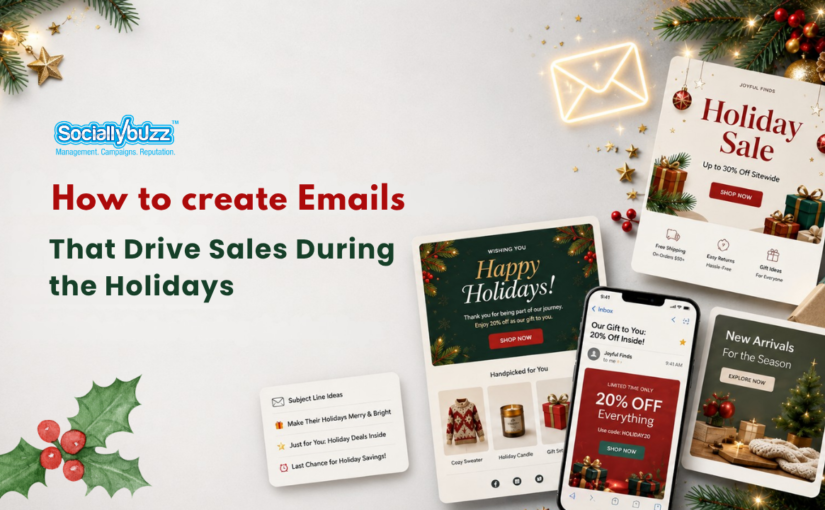
The holiday season can be one of the biggest revenue opportunities of the year.
It can also be one of the hardest times to get anyone’s attention.
By November, your customers’ inboxes are competing with Black Friday promotions, gift guides, shipping reminders, flash sales, loyalty offers, Christmas campaigns and dozens of brands all trying to create urgency at the same time.
That means simply sending more emails is not a holiday email marketing strategy.
The businesses that have the strongest opportunity to perform during the holidays are the ones that start earlier, understand who they are emailing, plan campaigns around actual shopping moments and use customer behavior to determine what people should receive next.
The opportunity is significant.
Adobe reported that U.S. consumers spent a record $257.8 billion online during the November–December 2025 holiday season, an increase of 6.8% year over year. Mobile devices accounted for a record 56.4% of online holiday spending.
But businesses are competing for those sales long before Christmas arrives.
According to the National Retail Federation, 42% of holiday shoppers planned to start browsing and buying before November in 2025, while 60% still expected to finish their shopping during December.
That creates a much longer email marketing window than many businesses realize.
So, how should your business approach holiday email marketing in 2026?
LISTEN TO THE LIVE PODCAST BELOW
One of the biggest mistakes businesses can make is waiting until Black Friday to start talking about the holidays.
By then, many customers are already shopping.
The NRF found that one of the biggest reasons consumers start early is to spread out their budgets, while others want to avoid the stress of last-minute shopping.
For businesses, that means September and October should not necessarily be quiet months before the “real” holiday campaign starts.
They are preparation months.
This is when you can build your audience, clean your email list, prepare automations, identify customer segments, develop your offers and start creating awareness around what is coming.
Then, as shopping intent increases, your email strategy can shift from awareness toward conversion.
By December, your messaging may shift again toward convenience, availability, shipping deadlines, gift cards and last-minute purchasing.
Instead of thinking of holiday email marketing as one promotion, think of it as a customer journey that changes throughout the season.
Before worrying about your Black Friday subject line, make sure you actually have an engaged audience to send it to.
September and October are excellent opportunities to grow your email list before inbox competition becomes even more intense.
Businesses can encourage sign-ups through:
But avoid relying on a generic:
“Subscribe to our newsletter.”
Give people a clear reason to join.
For example:
Get Early Access to Our Holiday Sale
Join the VIP Black Friday List
Get Our 2026 Holiday Gift Guide
Be First to Know About Holiday Deals
Unlock Subscriber-Only Holiday Offers
This changes the value exchange.
The customer is not simply signing up to receive more marketing.
They are receiving something useful or exclusive in return.
And the earlier you build that audience, the more opportunities you have to establish a relationship before your biggest promotional emails arrive.
Your best customer should not necessarily receive the same holiday email as someone who joined your list yesterday.
Someone who purchased from you last week probably should not receive the same “Come back and shop” promotion as someone who has not purchased in a year.
Holiday email becomes much more useful when businesses segment customers based on their relationship with the brand.
Possible segments include:
Then adjust the message.
A loyal customer might receive:
You Get First Access
A new subscriber might receive:
Here’s 15% Off Your First Holiday Order
Someone who abandoned their cart could receive:
Still Thinking About It? Your Holiday Picks Are Waiting
A previous customer could receive:
Something Special for Our Returning Customers
The question becomes less about:
“What email should we send today?”
and more about:
“What does this particular customer need to hear next?”
That difference can make holiday email feel far more relevant.
Black Friday and Cyber Monday have conditioned shoppers to expect deals.
But competing only on discount depth can quickly become expensive.
Recent data suggests businesses do not always have to offer the biggest discount to generate results.
During Black Friday Cyber Monday 2025, brands using Klaviyo saw consumer spending increase 11% year over year even as average discount rates fell by roughly 10%. Klaviyo also reported that repeat purchases grew faster than purchases from new customers during the period.
That reinforces an important point:
Value does not always have to mean the lowest price.
Instead of automatically offering another percentage discount, businesses could test:
A service business could promote a special year-end package.
A restaurant could sell holiday gift cards.
A fitness business could promote January memberships.
A professional service provider could open a limited number of January consultation slots.
Your offer ultimately needs to answer:
Why should the customer take action now?
One promotional email should not carry your entire holiday marketing strategy.
Customers may see the email while they are working.
They might open it but get distracted.
They might want to compare products.
They might be interested but not ready to purchase yet.
That is why strong holiday email marketing typically works as a sequence.
For example, a Black Friday campaign could include:
Email 1: The Teaser
Something is coming.
Email 2: Early Access
VIP customers or subscribers get the opportunity first.
Email 3: Promotion Launch
The main Black Friday offer goes live.
Email 4: Reminder
Highlight best sellers, customer favorites or another benefit of the promotion.
Email 5: Last Chance
Communicate an actual deadline and give customers a final opportunity to purchase.
Cyber Monday can then provide another reason to communicate, followed by December gifting campaigns.
The goal is not to repeat the exact same email five times.
Each message should provide a different reason to pay attention.
Once you know you need a sequence, the next question becomes:
When should you send it?
One of the easiest ways to structure holiday email marketing is to build campaigns around actual shopping moments.
You do not need to participate in every date.
Instead, select the opportunities that make sense for your audience, products, services and brand.
| Date | Holiday / Sales Moment | Email Opportunity |
|---|---|---|
| October 31 | Halloween | Seasonal promotions, themed offers, fall campaigns, bundles or limited-edition products |
| November 26 | Thanksgiving | Customer appreciation, gratitude campaigns, VIP early access and Black Friday previews |
| November 27 | Black Friday | Main promotional campaign, limited-time offers, bundles, discounts or exclusive releases |
| November 28 | Small Business Saturday | Shop-small messaging, local campaigns, founder stories, customer appreciation and community-focused offers |
| November 30 | Cyber Monday | Online-exclusive offers, ecommerce promotions, free shipping or final BFCM campaigns |
| December 1 | GivingTuesday | Charitable initiatives, community partnerships or cause-related campaigns |
| December 14 | Green Monday | Gift recommendations, ecommerce offers and shipping-focused reminders |
| December 19 | Super Saturday | Last-minute gifts, local shopping, pickup options, expedited delivery and gift recommendations |
| December 24 | Christmas Eve | Digital gift cards, subscriptions, experiences and instant-delivery gifts |
| December 26–31 | Post-Christmas / Year-End | Clearance, self-gifting, gift-card redemption, year-end offers and January promotions |
| January 1, 2027 | New Year | January bookings, fresh-start campaigns, subscriptions, memberships and new-year offers |
In 2026, Black Friday falls on November 27, with Cyber Monday following on November 30.
Small Business Saturday falls between them on November 28, 2026, creating an especially useful opportunity for independent and local businesses.
Later in the season, Green Monday falls on December 14, 2026. The shopping event has traditionally been associated with one of the final opportunities to confidently order ecommerce gifts in time for Christmas.
This should not become a checklist requiring your business to create a sale for every occasion.
Choose dates strategically.
A retailer might prioritize:
Black Friday → Cyber Monday → Green Monday → Super Saturday → Christmas Eve
A local small business might prioritize:
Thanksgiving → Small Business Saturday → December Local Shopping → Christmas Eve
A service business might focus more heavily on:
Thanksgiving → Year-End Availability → Christmas Gift Certificates → New Year Bookings
Think of these dates as anchors.
Instead of sitting down every week and asking:
“What should we email people about?”
your marketing team can look ahead and ask:
“What buying moment is coming next, and what will our customer need from us?”
That gives your email calendar purpose.
During the holiday season, your email may be sitting next to 20 other promotional messages.
Your subject line has to give someone a reason to choose yours.
This does not mean every email needs to look like this:
🚨🔥 LAST CHANCE!!! HUGE HOLIDAY SALE!!! 🔥🚨
In many cases, clarity is stronger than hype.
Mailchimp recommends keeping subject lines relatively concise — generally no more than around nine words or 60 characters — particularly because shorter subject lines are easier to read on mobile devices. It also recommends descriptive language, thoughtful personalization and restrained emoji use.
Compare:
Generic:
Holiday Savings Are Here!
More Specific:
25% Off Ends Tonight
Or:
Generic:
Find the Perfect Gift
More Useful:
5 Gifts Under $50 They’ll Actually Use
The second versions immediately communicate what the customer receives by opening.
Your preview text should then add another piece of information rather than simply repeating the subject line.
For example:
Subject: 5 Gifts Under $50 They’ll Actually Use
Preview: Plus, get free shipping when you order by Friday.
Now the customer has two reasons to open.
Your holiday campaign might look beautiful when viewed on a desktop monitor.
But that may not be where customers actually shop.
Adobe found that mobile accounted for 56.4% of U.S. online holiday spending during the 2025 holiday season.
Businesses therefore need to consider the entire mobile experience.
That means:
Most importantly, make your primary action obvious.
If the purpose of the email is to drive customers toward a sale, use a direct CTA such as:
SHOP THE HOLIDAY SALE
GET EARLY ACCESS
SHOP GIFTS UNDER $50
RESERVE YOUR SPOT
GET YOUR GIFT CARD
Avoid making customers work to understand what they should do next.
Your scheduled holiday campaigns create attention.
Your automated emails help capture intent.
Imagine someone clicks your holiday promotion and browses several products.
They add something to their cart.
Then they leave.
Without automation, that customer might disappear.
With automation, your business can continue the conversation.
Recent Omnisend research based on activity across approximately 150,000 ecommerce brands found that automated emails generated 30% of email revenue in 2025 despite representing only 2% of email sends.
That makes automation especially important when holiday website traffic increases.
At minimum, businesses should consider preparing:
For people joining your holiday list for the first time.
For customers who viewed products but did not purchase.
For customers who placed something in their cart and left.
Useful when popular holiday products sell out and become available again.
For order information, cross-selling, customer education and future purchases.
For previous customers who have not purchased recently.
The best time to build and test these systems is before your biggest holiday traffic arrives.
You do not want to discover during Black Friday weekend that your abandoned-cart flow was never activated.
Putting:
“Hi, Sarah”
at the beginning of an email is technically personalization.
But businesses can go much further.
Holiday personalization can be based on:
Someone who regularly purchases skincare should not necessarily see the same gift recommendations as someone who buys children’s products.
A VIP customer could receive early access.
A customer who purchased last week might receive complementary product recommendations instead of another generic sale announcement.
The goal is to make choosing easier.
Instead of:
Shop Our Holiday Collection
consider:
Based on What You Loved Last Time, Here Are 5 Gifts We Think You’ll Like
The more relevant the email feels, the less it feels like another mass promotion.
Holiday shoppers often do not know exactly what they want.
They know who they need to buy for.
That creates an opportunity for email marketing to become genuinely useful.
Instead of organizing every email around your product categories, organize some campaigns around the problem the shopper is trying to solve.
For example:
Gifts Under $25
Gifts Under $50
Gifts for Mom
Gifts for Dad
Gifts for Coworkers
Gifts for the Person Who Has Everything
Best Sellers of 2026
Last-Minute Gifts
Gifts That Still Arrive Before Christmas
Digital Gifts You Can Send Instantly
You can also build guides around interests.
For example:
For the Coffee Lover
For the Homebody
For the Fitness Fan
For the Entrepreneur
For the Traveler
Gift guides reduce the number of decisions customers need to make.
As Christmas gets closer, that convenience becomes increasingly valuable.
A customer shopping on December 5 does not necessarily have the same priorities as someone shopping on December 23.
Earlier in December, your campaign can focus on inspiration:
Our Most-Loved Gifts This Christmas
The 2026 Holiday Gift Guide
10 Gifts Under $50
As shipping deadlines approach, the message becomes more practical:
Order by Friday for Christmas Delivery
Last Day for Standard Shipping
Still Need a Gift? We Can Help
Then, once physical shipping is no longer realistic, switch the offer.
Promote:
Strong holiday email marketing adapts to what the customer needs at that moment.
Getting the holiday sale is important.
Keeping the customer can be even more valuable.
Someone who purchased during Black Friday or Christmas has already crossed one of the hardest hurdles:
They trusted your business enough to buy.
Your email strategy should continue after checkout.
Useful post-purchase emails can include:
Klaviyo’s 2025 BFCM data found repeat-purchase growth outpaced growth among new buyers, reinforcing the value of existing customer relationships during peak shopping periods.
Holiday customer acquisition becomes much more valuable when the relationship continues into 2027.
There is another important part of holiday email marketing that customers never see:
Deliverability.
You could have the perfect campaign, subject line and offer.
None of it matters if your email lands in spam.
Businesses increasing their email volume for the holidays should make sure their lists are clean, recipients have properly opted in and their sending infrastructure is configured correctly.
Google currently requires senders delivering email to personal Gmail accounts to meet specific authentication and sending standards.
Businesses sending more than 5,000 messages per day to Gmail accounts face additional requirements including SPF, DKIM and DMARC authentication, maintaining low spam complaint rates and supporting one-click unsubscribe for applicable marketing emails. Google also increased enforcement against non-compliant bulk senders beginning in November 2025.
That means businesses should check deliverability before suddenly increasing email volume for Black Friday.
Also avoid sending holiday campaigns to old databases that have not heard from your company in years.
More email addresses do not automatically mean better results.
An engaged list is far more valuable than a large list filled with people who no longer want your messages.
Everything in this guide is not exclusively for ecommerce.
Service businesses can use the same holiday email principles differently.
Instead of pushing physical products, your email campaign could promote:
B2B businesses can also adapt their messaging.
Rather than:
30% Off for Black Friday
a marketing company, consultant or professional service business might communicate:
Planning to Grow in 2027? Start Before January.
Or:
We’re Opening 5 January Client Spots.
Or:
Use the Rest of 2026 to Build Your Q1 Strategy.
The format changes.
The underlying strategy does not.
Identify what your customer is thinking about during this period and give them a timely reason to act.
Do not judge an entire holiday email strategy based only on open rates.
Open rates can give you useful directional information, but businesses should connect email performance with actual customer behavior.
Track metrics such as:
Are people taking the next step?
Are email recipients actually completing your desired action?
How much revenue can be attributed to email campaigns?
Which campaigns and audience segments produce the most value?
Are certain promotions increasing or reducing how much customers spend?
How much otherwise-lost revenue is being recovered through automation?
Are you increasing your send volume so aggressively that subscribers are leaving?
Are holiday customers coming back?
Are the customers acquired during the holiday period becoming valuable long-term customers?
The goal is not to send the most holiday emails.
The goal is to generate the most valuable customer actions.
Holiday email marketing in 2026 should not consist of one Christmas newsletter and a Black Friday discount.
Consumers shop across a much longer holiday window.
They browse early.
They purchase during major promotional periods.
They continue shopping through December.
And their needs change as Christmas gets closer.
The businesses in the strongest position will be the ones that prepare for those moments before they happen.
Build your audience early.
Segment your customers.
Plan campaigns instead of isolated emails.
Use the holiday sales calendar to identify natural reasons to communicate.
Develop offers based on more than discounts.
Automate high-intent customer journeys.
Personalize recommendations.
Design for mobile.
Adapt your messaging as deadlines approach.
And continue nurturing customers after they purchase.
Because effective holiday email marketing is not about sending another message that says:
“Buy now.”
It is about reaching the right customer with the right message, offer and reason to act at the moment they are most likely to need it.
Businesses should ideally begin preparing their holiday email strategy by September or early October. This gives teams time to build their audience, create customer segments, test automations and prepare campaigns before peak shopping periods begin.
With 42% of surveyed 2025 holiday shoppers planning to begin before November, waiting until Black Friday can mean missing a significant portion of early demand.
Some of the biggest opportunities include Thanksgiving on November 26, Black Friday on November 27, Small Business Saturday on November 28, Cyber Monday on November 30, Green Monday on December 14 and the final shopping period leading into Christmas.
Businesses should select the dates that are most relevant to their customers rather than creating a promotion for every occasion.
There is no universal number.
Instead of choosing a fixed frequency, consider audience engagement and customer intent.
Someone actively browsing your website, joining your Black Friday list or abandoning a cart may reasonably receive more communication than an inactive subscriber who has not engaged with your business in months.
No.
Offers can include free shipping, bundles, gifts with purchase, early access, exclusive products, loyalty rewards, limited availability, gift certificates and other incentives.
Recent BFCM performance data also shows that deeper discounts are not always necessary for stronger sales performance.
Useful automations include welcome emails, browse abandonment, cart abandonment, back-in-stock notifications, post-purchase campaigns and customer win-back campaigns.
Behavior-based automated emails generated a disproportionately high share of email revenue in Omnisend’s 2025 data, making these flows particularly important during high-traffic periods.
A good holiday subject line clearly communicates why the recipient should open the email.
Highlight the offer, customer benefit, deadline or content whenever possible.
Shorter subject lines are also easier to read on mobile devices. Mailchimp recommends staying within approximately nine words or 60 characters as a general guideline.
Yes.
Service businesses can promote gift certificates, limited availability, consultations, packages, subscriptions, memberships and January bookings.
The offer should reflect how customers naturally purchase from the business rather than trying to imitate ecommerce Black Friday campaigns.
The holiday season creates enormous buying intent.
It also creates enormous competition.
Standing out in the inbox does not necessarily mean emailing more frequently or offering the biggest discount.
It means being more relevant.
Know who you are talking to.
Know what shopping moment they are in.
Know what they need next.
Then build an email strategy around that.
When your campaigns, automation, website, offers and broader holiday marketing strategy work together, email becomes much more than another promotional channel.
It becomes a system for turning holiday attention into measurable business growth.
If you need help in building your e-mail marketing campaigns this holiday season. Schedule a one-on-one call with us today!
Subscribe now to receive relevant social media information, tips, tricks and service updates.