

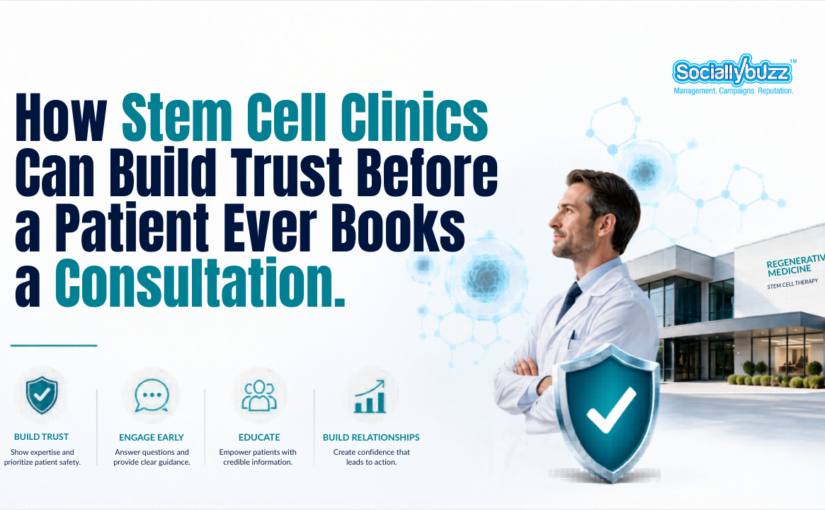
Stem cell therapy is not the type of service someone usually books after seeing one ad, one social media post, or one website page.
Before a potential patient contacts a clinic, they may spend days or even weeks researching online. They may search Google, watch videos, read clinic websites, compare providers, look at reviews, and ask themselves whether this is something they should explore further.
That means trust starts long before the first consultation.
For stem cell clinics, being found online is only the first step. Once someone discovers the clinic, the next question is: does this clinic make me feel informed enough to reach out?
This matters because stem cell therapy and regenerative medicine are high-consideration healthcare topics. Patients may be hopeful, but they may also be cautious. They may have questions about safety, eligibility, cost, expectations, provider credentials, and what actually happens during the consultation.
This is why marketing for stem cell clinics cannot only focus on promotion. It needs to educate. It needs to clarify. It needs to show expertise. It needs to answer questions before the patient even speaks to the clinic.
In the regenerative medicine space, responsible communication is especially important. The FDA has warned that many regenerative medicine products, including certain stem cell and exosome products, are marketed with misleading claims, and that most stem cell products require FDA approval before they can be marketed for use in the United States. The FTC has also taken action against deceptive stem cell treatment marketing claims, including cases involving unproven treatment claims.
For clinics, this creates a clear marketing opportunity: build trust by being educational, transparent, and responsible before asking someone to book a consultation.
LISTEN TO THE LIVE PODCAST
One of the biggest mistakes stem cell clinics can make is sounding too promotional too early.
A potential patient may not be ready to book the first time they visit the website. They may still be trying to understand what stem cell therapy is, what regenerative medicine means, whether they may be a candidate, and what questions they should ask before considering a consultation.
If the clinic’s first message is only “Book Now” or “Schedule Today,” it may feel rushed. The patient may leave because they still do not have enough information.
Education creates a softer and more helpful entry point.
Instead of pushing the patient to act immediately, educational content helps them understand the topic better. It gives them a reason to stay on the website, watch the video, read the article, or follow the clinic for more information.
Instead of only posting:
Book your stem cell therapy consultation today.
A clinic could create content such as:
5 Questions to Ask Before Considering Stem Cell Therapy
What Happens During a Regenerative Medicine Consultation?
How to Prepare for Your First Visit With a Regenerative Medicine Provider
What Patients Should Know Before Comparing Stem Cell Clinics
This kind of content helps the clinic become part of the patient’s research process.
It does not pressure the reader. It helps them feel more prepared.
Stem cell clinics should not hide their experts behind generic marketing copy.
Potential patients want to know who is evaluating them, who is explaining their options, and who is responsible for the clinical process. If a clinic has qualified physicians, medical directors, or clinical experts, those people should be visible in the marketing.
Doctor-led content can build credibility because it puts a real expert in front of the patient before the consultation happens.
This does not mean every piece of content has to be complicated or heavily medical. In fact, the most effective expert content is often simple, clear, and patient-friendly.
A doctor or clinical expert could record short videos answering common questions, such as:
What should patients ask before choosing a regenerative medicine clinic?
Why is a consultation important before discussing treatment options?
What should patients bring to their first appointment?
Why does every patient need an individual evaluation?
These videos can then be used across multiple channels.
One doctor-led video can become a YouTube video, a short social media clip, a blog section, an FAQ answer, an email newsletter, and a Google Business Profile update.
This allows the clinic to build expert visibility without constantly starting from scratch.
Uncertainty creates hesitation.
A potential patient may be interested in stem cell therapy, but they may not know what happens after they submit a form or call the clinic.
They may wonder:
Will I speak to a doctor?
Will I be pressured to commit?
Do I need medical records?
How long does the consultation take?
What questions will I be asked?
What happens after the consultation?
If the clinic does not answer these questions clearly, the patient may delay taking action.
A clear consultation process helps remove friction. It makes the next step feel less intimidating.
A clinic could add a page or section called:
What to Expect During Your Consultation
Then explain the process in simple steps:
First, the clinic reviews your inquiry and basic information.
Next, the team schedules a consultation or initial conversation.
During the consultation, the provider reviews your concerns, health history, goals, and questions.
The provider explains what options may be appropriate to discuss further based on the patient’s individual situation.
The patient receives next steps based on the evaluation.
This gives potential patients a clearer picture of what will happen before they ever reach out.
Some potential patients have questions they may feel embarrassed or nervous to ask directly.
They may be wondering about cost, eligibility, risks, safety, recovery time, results, or whether stem cell therapy is even appropriate for their situation.
If a clinic does not address these concerns, patients may look elsewhere for answers. And in a space filled with mixed information online, that can lead to confusion.
Clinics can build trust by answering these questions proactively in a responsible and easy-to-understand way.
A clinic could create an FAQ page, blog series, or video series around questions like:
Is everyone a candidate for regenerative medicine?
What should I ask before choosing a stem cell clinic?
Why is a medical evaluation important before discussing treatment options?
What should patients understand about regenerative medicine claims online?
How should patients compare clinics offering stem cell therapy?
The FDA advises consumers to ask whether regenerative medicine products are FDA-approved or whether they are being studied under FDA oversight in a clinical trial, which makes patient education especially important in this space.
A responsible clinic can use content to help patients ask better questions before they make decisions.
Trust can disappear quickly when marketing sounds too good to be true.
In the stem cell and regenerative medicine space, overpromising is especially risky. Claims like “cure arthritis,” “avoid surgery guaranteed,” “reverse disease,” or “pain-free results for everyone” may sound persuasive, but they can also make potential patients skeptical.
They can also create compliance concerns.
A stronger approach is to use responsible, consultation-focused language that invites people to learn more without promising a specific result.
Instead of saying:
Stem cell therapy will eliminate your knee pain.
A more responsible message would be:
If you are exploring options for joint discomfort, our team can evaluate your situation, explain available regenerative medicine approaches, and discuss whether you may be a candidate.
Instead of saying:
Avoid surgery with stem cell therapy.
A more careful version would be:
For patients exploring non-surgical options, a consultation can help determine what approaches may be appropriate based on their individual situation.
This kind of language is still clear and marketable, but it does not overstate what the clinic can promise.
Potential patients want to know who is behind the clinic.
They may ask themselves:
Who will evaluate me?
What is the provider’s background?
Is there a medical doctor involved?
What experience does the team have?
Why should I trust this clinic?
If provider credentials are hidden or vague, the clinic may lose credibility.
A strong website should make the clinical team easy to understand. Provider bios should be clear, complete, and written in patient-friendly language.
Instead of a short bio that only says:
Dr. Smith is the Medical Director of our clinic.
A stronger provider section could say:
Dr. Smith serves as the Medical Director of [Clinic Name], where he helps patients understand their options through a consultation-first approach. During appointments, he reviews each patient’s concerns, health history, and goals before discussing whether regenerative medicine may be appropriate to explore.
The provider page can also include education, training, certifications, areas of focus, professional memberships, a professional photo, and a short video introduction.
This gives potential patients more context before they inquire.
Patient testimonials can support credibility, but stem cell clinics need to use them carefully.
In healthcare marketing, testimonials should not imply that every patient will get the same result. They should also avoid exaggerated claims that could be interpreted as guaranteed outcomes.
For stem cell clinics, testimonials are often safest when they focus on the patient experience rather than making medical claims.
A risky testimonial may say:
Stem cell therapy cured my knee pain completely. Everyone should do this.
A more responsible testimonial may say:
The team took time to explain the consultation process and answer my questions. I felt informed before making any decisions.
The second testimonial still communicates a positive experience, but it does not promise a medical outcome.
Clinics can also include a simple note such as:
Individual experiences may vary. A consultation is required to determine whether regenerative medicine may be appropriate for your situation.
This allows testimonials to support trust without turning them into unrealistic promises.
FAQs are one of the most useful trust-building tools for stem cell clinics.
They help potential patients get answers quickly. They also allow the clinic to explain complex topics in a simple and responsible way.
A basic FAQ page is helpful. A doctor-led FAQ library is even stronger.
This gives the content more authority because the answers are connected to the clinic’s clinical team.
A clinic could create a content section called:
Doctor Answers: Common Questions About Regenerative Medicine
Questions could include:
What is discussed during a regenerative medicine consultation?
Why do patients need to be evaluated before treatment is discussed?
What should patients know before choosing a clinic?
Can every patient receive stem cell therapy?
What records should I bring to my appointment?
Each answer can be reviewed by the clinical team and written in plain language.
To make the content more engaging, the clinic can record short doctor-led videos answering each question and place them on the website, YouTube, and social media.
People trust people more than faceless businesses.
For stem cell clinics, showing the team behind the practice can make the clinic feel more approachable and easier to contact.
A potential patient may feel nervous before booking a consultation. Seeing the doctor or clinic team speak calmly and professionally can make the first step feel less intimidating.
A clinic could create a Meet the Doctor video where the provider answers:
Who are you?
What is your role at the clinic?
How do you approach patient consultations?
What do you want patients to understand before booking?
What should patients expect when they visit the clinic?
The clinic could also create short team spotlight posts featuring patient coordinators, nurses, front desk staff, or clinical team members.
This matters because patients may interact with several people before booking. When the online experience already makes the team feel familiar, the first call can feel easier.
A clinic website should not only list services.
It should help potential patients understand what the clinic does, who it helps, what the process looks like, who the providers are, and how to take the next step.
A website that feels too promotional may create hesitation. A website that feels educational and organized can help potential patients stay longer and learn more.
Instead of structuring the website only around service pages, a stem cell clinic could include:
A patient education center
A regenerative medicine FAQ
A consultation process page
A provider credentials page
A blog with common patient questions
A video library
A page explaining how to prepare for a consultation
A clear request information page
This turns the website into a resource hub.
A visitor who is not ready to inquire can still learn. A visitor who is ready can easily find the next step.
Not every potential patient will book immediately after visiting the website.
Some people need time. They may want to read more, talk to a family member, compare clinics, or prepare questions.
That is why email can be useful.
If someone downloads a guide, registers for a webinar, or requests more information, the clinic can continue educating them through email.
A clinic could offer a downloadable guide called:
7 Questions to Ask Before Choosing a Regenerative Medicine Clinic
After someone downloads it, the clinic can send a short email sequence:
Email 1: What to expect during a consultation
Email 2: Questions to ask before choosing a provider
Email 3: Why provider credentials matter
Email 4: How to prepare for your appointment
Email 5: Invitation to request a consultation
This keeps the clinic connected to the potential patient without being pushy.
The emails should feel helpful, not aggressive.
Trust is built through repeated exposure.
A potential patient may not book after reading one article or watching one video. But if they continue seeing the clinic share helpful, expert-led content, the clinic becomes more familiar over time.
This is why repurposing matters.
One strong piece of expert content can become multiple assets across different platforms.
A doctor records a 5-minute video answering:
What should patients ask before choosing a stem cell clinic?
That one video can become:
A YouTube video
A short Reel
A LinkedIn post
A blog article
A website FAQ
An email newsletter
A carousel post
A Google Business Profile update
This allows the clinic to build a consistent expert presence without creating every asset from scratch.
Trust-building content should always guide people toward a next step.
But for stem cell clinics, that next step should feel approachable and low-pressure.
Instead of pushing people to commit to treatment immediately, the clinic can invite them to request more information, ask a question, or book a consultation.
A strong call-to-action could say:
Have questions about regenerative medicine? Request a consultation with our team to learn more about your options.
Or:
Not sure where to start? Speak with our clinic team and learn what to expect during your first consultation.
These CTAs feel more approachable than:
Get treated now.
The goal is to make the first step feel easy, safe, and clear.
For stem cell clinics, trust does not begin inside the consultation room.
It begins online.
It begins when a potential patient finds an article that answers their question. It grows when they watch a doctor explain the process clearly. It strengthens when they see provider credentials, responsible language, helpful FAQs, and a website that feels organized around patient education.
The clinics that build trust before the first inquiry are more likely to attract people who are informed, engaged, and ready to have a meaningful conversation.
In a sensitive and high-consideration space like stem cell therapy, that matters.
Sociallybuzz helps businesses create marketing systems that connect visibility, content, and lead generation.
For stem cell clinics, that means building a digital presence that does more than attract attention. It helps educate potential patients, highlight provider expertise, answer common questions, and guide interested people toward a consultation.
Sociallybuzz can help with doctor-led content planning, website messaging, educational blog writing, YouTube video topics and scripts, short-form video repurposing, FAQ development, email nurture campaigns, social media content, Google Business Profile updates, and lead generation funnels.
The goal is not to create hype.
The goal is to help stem cell clinics communicate clearly, responsibly, and consistently so potential patients feel informed enough to take the next step.
If your stem cell clinic wants to build trust before a patient ever books a consultation, Sociallybuzz can help you create the content, messaging, and marketing system to make that happen.
Trust is important because stem cell therapy is a high-consideration healthcare decision. Potential patients may spend time researching, comparing clinics, reading reviews, and watching videos before they ever book a consultation. If your clinic does not clearly educate and reassure them online, they may hesitate to take the next step.
Stem cell clinics can build trust by creating educational content, featuring doctors and clinical experts, explaining the consultation process clearly, answering common patient questions, showing provider credentials, using responsible language, and making the website feel like a helpful patient resource instead of only a sales page.
Doctor-led content helps potential patients see the people behind the clinic. When a medical doctor or clinical expert answers common questions through videos, blogs, FAQs, or social posts, the clinic feels more credible and approachable before the patient ever speaks to the team.
Stem cell clinics can create content around common patient questions, such as what to expect during a consultation, what to ask before choosing a regenerative medicine clinic, how patients are evaluated, what records to bring, and why individual consultation matters before discussing treatment options.
Overpromising can damage trust and create compliance concerns. Claims that sound too good to be true may make potential patients skeptical. A stronger approach is to use responsible, consultation-focused language that explains the clinic’s process without guaranteeing specific medical outcomes.
Testimonials can help when they focus on the patient experience, such as how clearly the team explained the process or how professional the consultation felt. Clinics should avoid using testimonials that imply guaranteed results or make broad medical claims.
A stem cell clinic website should include provider bios, credentials, consultation process details, patient FAQs, educational articles, doctor-led videos, clear service explanations, and a simple way to request more information or book a consultation.
Email marketing helps clinics stay connected with people who are interested but not ready to book yet. A clinic can send educational emails that explain the consultation process, answer common questions, introduce providers, and guide potential patients toward making a more informed decision.
A good call-to-action should feel clear and low-pressure. Instead of saying “Get treated now,” a clinic can say “Request a consultation,” “Speak with our team,” or “Learn what to expect during your first consultation.” This makes the next step feel easier and less intimidating.
Sociallybuzz can help stem cell clinics create doctor-led content, educational blogs, FAQs, website messaging, social media content, email nurture campaigns, video scripts, Google Business Profile updates, and lead generation funnels designed to educate potential patients and guide them toward a consultation.
Subscribe now to receive relevant social media information, tips, tricks and service updates.