

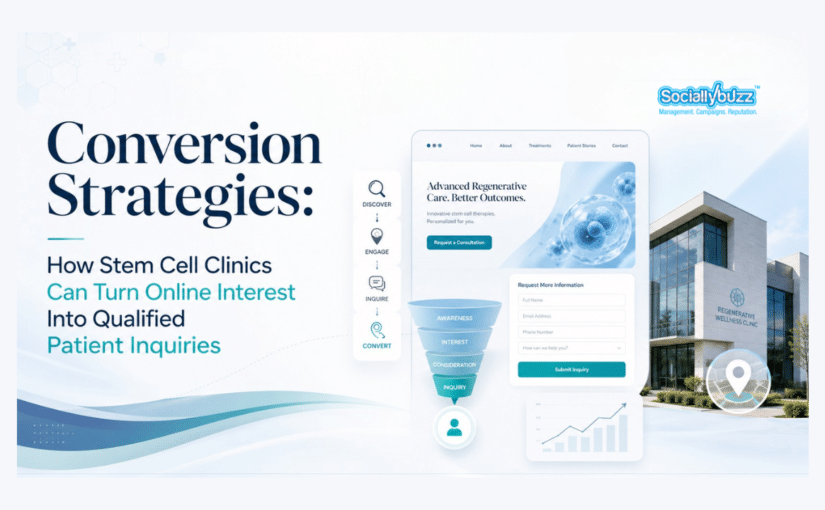
Getting found online is important.
Building trust is important.
But for stem cell clinics, visibility and trust are only part of the marketing journey.
The next question is: how do you turn online interest into qualified patient inquiries?
A potential patient may find your clinic on Google. They may visit your website. They may read a blog article. They may watch a doctor-led video. They may scroll through your social media or check your Google Business Profile.
But if there is no clear next step, no helpful follow-up, or no simple way to inquire, that interest can disappear.
That is why conversion strategy matters.
For stem cell clinics, conversion does not mean pressuring someone into treatment. It means creating a clear, responsible, and helpful path for interested people to request more information, ask questions, or book a consultation.
This is especially important in regenerative medicine because patients may be cautious. The FDA has warned consumers about unapproved regenerative medicine products, including certain stem cell and exosome products, and continues to warn patients about risks connected to unapproved products marketed online for a wide range of diseases or medical conditions.
That means stem cell clinics need conversion strategies that are not hype-driven. They need systems built around clarity, education, and qualified inquiries.
LISTEN TO THE LIVE PODCAST HERE
One of the biggest conversion mistakes clinics make is sending every visitor to the same general homepage.
A homepage is useful, but it is not always the best place to send someone who has a specific interest.
If someone clicks an ad, social post, Google result, or email about stem cell therapy consultation, they should land on a page that matches what they were looking for.
A strong landing page should focus on one clear topic, answer the most important questions, and guide the visitor toward one main action.
Instead of sending everyone to the homepage, a clinic could create landing pages such as:
Stem Cell Therapy Consultation in [City]
Regenerative Medicine Consultation for Joint Pain
What to Expect During a Regenerative Medicine Consultation
Speak With Our Team About Regenerative Medicine Options
Each page should include:
A clear headline
A short explanation of who the page is for
What the consultation involves
Provider or clinic information
Common questions
A simple form or call button
A clear next step
For example, if someone searches “stem cell therapy consultation near me,” the landing page should immediately confirm that they are in the right place. It should not make them dig through the website to figure out what to do next.
Not every potential patient is ready to book immediately.
Some are ready for a consultation. Some only want to ask a question. Some want to download information first. Some want to understand the process before speaking to anyone.
If your only call-to-action is “Book Now,” you may lose people who are interested but not ready.
A better conversion strategy gives people a few clear pathways based on their level of readiness.
A clinic could use different CTAs for different stages:
For someone ready to talk:
Request a Consultation
For someone with questions:
Speak With Our Team
For someone still researching:
Download the Patient Guide
For someone comparing options:
Learn What to Expect During Your First Visit
These CTAs feel more approachable than aggressive treatment-focused language.
Instead of saying:
Start stem cell therapy today.
A more responsible CTA could be:
Request a consultation to learn whether regenerative medicine may be appropriate for your situation.
This invites the right next step without overpromising.
A long or confusing inquiry form can quietly reduce conversions.
Potential patients may already feel unsure. If the form asks too many questions too soon, they may abandon it.
The goal of the first inquiry form is not to collect every detail. The goal is to make it easy for an interested person to raise their hand and start a conversation.
A complicated form may ask for:
Full medical history
Insurance details
Treatment preferences
Long symptom descriptions
Multiple required fields
Upload requirements
Detailed health background
That may be too much for the first step.
A simpler form could ask for:
Name
Phone number
Email address
Preferred contact method
Main concern or question
Best time to reach out
After the clinic receives the inquiry, the team can follow up and collect more detailed information if appropriate.
A shorter form lowers friction and makes it easier for potential patients to take the first step.
Many clinics ask people to submit a form but do not explain what happens next.
That uncertainty can stop people from completing the form.
A potential patient may wonder:
Will someone call me?
How soon will I hear back?
Will I be pressured?
Will I speak with a real person?
Do I need to prepare anything?
What will happen during the first conversation?
A simple explanation can make the form feel less intimidating.
Under the inquiry form, a clinic could add:
What happens after you submit this form?
Step 1: Our team reviews your inquiry.
Step 2: We contact you to learn more about your questions or concerns.
Step 3: If appropriate, we help you schedule a consultation.
Step 4: During the consultation, the provider reviews your situation and discusses possible next steps.
This helps the person understand the process before they click submit.
It also makes the clinic feel more organized and approachable.
Many people searching for stem cell therapy are using their phones.
If someone is ready to contact the clinic, they should not have to search for the phone number, copy it manually, or navigate through multiple pages.
A click-to-call button can make the inquiry process much easier.
A mobile visitor lands on a page about stem cell therapy consultation in [City].
At the top of the page, they see:
Call Our Clinic
Request a Consultation
As they scroll, the call button stays visible.
This matters because some potential patients prefer calling over filling out forms. Others may want to ask a quick question before deciding whether to schedule.
The easier it is to contact the clinic, the more likely interested visitors are to take action.
Not every website visitor is ready to inquire.
Some are still researching. If the clinic only offers a consultation CTA, it may lose those early-stage visitors completely.
A patient guide can help capture interest from people who are not ready to speak with the clinic yet.
This is where a lead magnet can be useful.
A clinic could offer a downloadable guide such as:
7 Questions to Ask Before Choosing a Regenerative Medicine Clinic
or
What to Know Before Booking a Stem Cell Therapy Consultation
To download the guide, the visitor enters their name and email address.
Then, the clinic can follow up with helpful educational emails.
This gives the clinic a way to stay connected with potential patients who are interested but not yet ready to book.
Many potential patients need time before they inquire.
They may want to talk to a spouse, compare clinics, think about cost, or continue researching.
If there is no follow-up system, the clinic may lose them.
Email nurture helps the clinic stay in front of interested people while continuing to educate them.
After someone downloads a guide or requests more information, the clinic can send a short email sequence:
Email 1: What to expect during a regenerative medicine consultation
Email 2: Questions to ask before choosing a clinic
Email 3: Meet the doctor or clinical team
Email 4: How to prepare for your first conversation
Email 5: Invitation to request a consultation
Each email should be helpful and simple.
The goal is not to pressure the person. The goal is to answer questions and guide them toward a consultation when they are ready.
Some people visit the website once and leave.
That does not always mean they are uninterested.
They may have been distracted. They may need more time. They may be comparing options. They may plan to come back later but forget.
Retargeting can help bring these visitors back by showing them relevant ads after they leave the website.
For stem cell clinics, retargeting should be educational and responsible, not aggressive.
Instead of retargeting with:
Book stem cell therapy now.
A clinic could retarget visitors with content like:
What to Expect During a Regenerative Medicine Consultation
Questions to Ask Before Choosing a Stem Cell Clinic
Meet Our Clinical Team
Download the Patient Guide
This keeps the clinic visible while continuing the education process.
Retargeting works best when it brings people back to helpful content, not just a hard sales message.
Video can help potential patients feel more comfortable before they contact the clinic.
A person may hesitate to inquire because they do not know who they will speak with or what the clinic experience will feel like.
Video can make the clinic more familiar.
A clinic could create short videos such as:
What Happens After You Submit an Inquiry?
Meet the Doctor: What to Expect During Your Consultation
How Our Team Reviews Patient Questions
What to Bring to Your First Appointment
These videos can be placed on landing pages, service pages, FAQ pages, emails, and social media.
A short video near the inquiry form can be especially helpful because it gives the visitor reassurance before they submit their information.
Not every inquiry will be a qualified patient inquiry.
Some people may be outside the service area. Some may be looking for a service the clinic does not offer. Some may be asking questions that require a different type of provider. Some may not be ready for a consultation.
The goal is not just to get more forms. The goal is to get better inquiries.
A good conversion system includes simple qualification questions that help the clinic understand who is reaching out.
A clinic’s inquiry form could include questions like:
What is your main concern or reason for reaching out?
Have you previously spoken with a provider about this concern?
What city or area are you located in?
How soon would you like to speak with someone?
What is your preferred contact method?
These questions help the clinic prioritize follow-up and better understand the inquiry.
The key is balance. Ask enough to qualify the lead, but not so much that the person abandons the form.
Once someone submits an inquiry, the follow-up process matters.
If the clinic takes too long to respond, the person may contact another clinic.
If the response is generic, the person may feel like just another lead.
If the team does not know where the inquiry came from, they may miss important context.
A conversion strategy should include a clear follow-up workflow.
A clinic could organize inquiries by source:
Google Business Profile call
Website consultation form
Downloaded patient guide
Facebook ad inquiry
YouTube video click
Email campaign response
Then the clinic can respond appropriately.
Someone who requested a consultation may need a faster call-back.
Someone who downloaded a guide may need a helpful email sequence.
Someone who clicked from a video may benefit from more educational content.
This helps the clinic respond based on the person’s level of interest.
Stem cell clinics should not only track website traffic.
Traffic tells you how many people visited. It does not tell you whether those visitors became inquiries.
A better conversion strategy tracks the actions that matter.
Important metrics may include:
Google Business Profile calls
Website form submissions
Click-to-call actions
Guide downloads
Consultation page visits
Landing page conversion rate
Email clicks
Retargeting ad clicks
Cost per inquiry
Qualified inquiry rate
For example, a clinic may find that one blog post gets a lot of traffic but very few inquiries. That may mean the page needs a better CTA.
Another clinic may find that its consultation landing page gets fewer visitors but more form submissions. That may mean the page is attracting higher-intent searchers.
Tracking helps the clinic improve the system over time.
Conversion problems often happen when the marketing journey feels disconnected.
A person clicks an ad about regenerative medicine consultations, but the link goes to a general homepage.
A person downloads a patient guide, but no one follows up.
A person fills out a form, but the confirmation message is vague.
Each step should connect clearly to the next.
A better journey could look like this:
A person searches for regenerative medicine options.
They click an ad or Google result for a consultation page.
The landing page explains what the consultation includes.
The page offers a simple form and clear next step.
After submitting, the person receives a confirmation message.
The clinic follows up quickly.
If the person is not ready, they enter an educational email sequence.
This creates a smoother path from interest to inquiry.
Conversion-focused marketing should not become aggressive or misleading.
This is especially important in stem cell and regenerative medicine marketing.
The FDA states that regenerative medicine products, including certain stem cell products, generally require FDA licensure or approval before they are marketed to consumers, and products not approved may be offered only under FDA oversight in a clinical trial.
The FTC’s Bureau of Consumer Protection also works to stop unfair, deceptive, and fraudulent business practices, which is relevant for healthcare marketing claims.
For clinics, responsible conversion messaging should focus on:
Consultation
Evaluation
Education
Eligibility
Provider review
Individual circumstances
Clear next steps
Instead of:
Reserve your treatment today and get guaranteed results.
A more responsible CTA would be:
Request a consultation to learn whether regenerative medicine may be appropriate for your individual situation.
Instead of:
Stem cell therapy can fix your pain.
A more careful message would be:
Speak with our team to learn more about your options and what to expect during a regenerative medicine consultation.
This keeps the marketing conversion-focused without relying on risky promises.
A stem cell clinic may already have online interest.
People may be visiting the website, reading content, watching videos, clicking ads, or viewing the Google Business Profile.
But interest alone does not create inquiries.
The clinic needs a clear conversion path.
That means building landing pages for specific patient interests, using CTAs that match readiness, simplifying forms, explaining next steps, offering patient guides, nurturing leads through email, using retargeting responsibly, adding video, qualifying inquiries, and tracking what works.
The goal is not just more leads.
The goal is more qualified inquiries from people who understand what the clinic offers and are ready to take the next step.
Sociallybuzz helps businesses build marketing systems that connect visibility, trust, and lead generation.
For stem cell clinics, that means creating a conversion-focused strategy that helps interested people move from online research to qualified inquiry.
Sociallybuzz can help with:
Landing page strategy
Website messaging
Conversion-focused CTAs
Inquiry form optimization
Lead magnet development
Email nurture campaigns
Retargeting campaign strategy
Video content planning
Social media repurposing
Google Business Profile updates
SEO blog content
Lead generation funnels
Analytics and performance tracking
The goal is to create a complete path from online interest to consultation request.
If your stem cell clinic is getting attention online but not enough qualified inquiries, Sociallybuzz can help you build the landing pages, content, follow-up, and lead generation system needed to turn interest into action.
Stem cell clinics need conversion strategies because online interest does not automatically turn into patient inquiries. A person may visit the website, read an article, watch a video, or click an ad, but if the next step is unclear, they may leave without contacting the clinic.
A qualified patient inquiry is an inquiry from someone who has a relevant concern, understands the clinic’s services, is within the clinic’s service area, and is ready or close to ready to speak with the team. The goal is not just to get more leads, but to attract people who are a better fit for the clinic’s consultation process.
Landing pages help by giving potential patients a focused page based on what they are searching for or interested in. Instead of sending everyone to a general homepage, clinics can create pages for specific topics like stem cell therapy consultation in [City], regenerative medicine consultation, or what to expect during a consultation.
Stem cell clinics should use clear, low-pressure calls-to-action such as Request a Consultation, Speak With Our Team, Download the Patient Guide, or Learn What to Expect During Your First Visit. These CTAs feel more approachable than aggressive treatment-focused language.
Inquiry forms should be simple because long or complicated forms can discourage potential patients from submitting their information. A basic form with name, phone number, email, preferred contact method, and main concern is often enough for the first step.
Email marketing helps clinics stay connected with people who are interested but not ready to book yet. A short nurture sequence can answer common questions, introduce the clinical team, explain the consultation process, and invite the person to request a consultation when they feel ready.
A patient guide is a downloadable resource that helps answer common questions before someone books a consultation. For example, a clinic could offer 7 Questions to Ask Before Choosing a Regenerative Medicine Clinic. This helps capture early-stage interest and gives the clinic a way to follow up through email.
Retargeting helps bring interested website visitors back after they leave. For stem cell clinics, retargeting should focus on helpful content, such as consultation guides, doctor-led videos, FAQs, or educational articles, instead of aggressive treatment promotions.
Stem cell clinics should track metrics such as website form submissions, click-to-call actions, consultation page visits, Google Business Profile calls, guide downloads, email clicks, landing page conversion rates, cost per inquiry, and qualified inquiry rate.
Sociallybuzz can help stem cell clinics create landing pages, website messaging, lead magnets, email nurture campaigns, retargeting strategies, video content, social media content, SEO blogs, and lead generation funnels designed to turn online interest into qualified patient inquiries.
Subscribe now to receive relevant social media information, tips, tricks and service updates.